21 September 2011

Local flavour- how much is too much?

The other day I was reading a book set in a part of India that I knew intimately a couple of decades back. The book sucked me in from the first page, and I was happily coasting along, wallowing in nostalgia, taking note of the changes in the landscape, meeting people I had virtually grown up with. It was a wonderful ride, one which I would have been happy to have go on forever.

And then suddenly, one of the characters said something she should not have. In real life, she would have been speaking in Bengali, but translated and transposed into English the sentence constuction would have been quite different from what she was attributed as saying. At that point, the book lost me. The descriptions which had mesmerised me started looking forced, the characters I had met shrunk a dimension and became mere cardboard cut outs, and the plot which was non-existant to start with became more noticeable in its absence. I put the book aside, and may never pick it up again.


I am sure I am not the only person this has happened to. When a book is set in a place and time that you know well, you subconsiously want the descriptions to exactly match your own memories and perceptions of that point in time and space. And when it deviates from what you expect it to be, you tend to be unforgiving.

The writer, one assumes, would aware of these heightened expectations, and do her best to meet them. But is that really feasible? Local flavour is good, but only as a mild seasoning agent. Sprinkle too much of it, and you run the risk of the spices taking over the taste of the entire dish. And you end up losing all the readers who haven't yet acquired a taste for that particular time and place. Which you do not want.

How then do you strike a balance between retaining the local flavour, remaining true to type, and yet not going overboard? Can't be easy. But something every writer should reach for.

Have you ever abandoned a book, because it behaved contrary to how you expected it to? In your writing, how do you deal with it?

20 September 2011

Topical Tuesday: The United Nations' International Day of Peace

Tomorrow is a special holiday. I hope some of you have heard about it, but I suspect many have not. It’s the International Peace Day. It’s funny, really, that it’s a relatively unknown date for most of us, while in reality it should be the most important of all. They make cards for Groundhog Day, after all, but I have yet to see one for the day in celebration of world peace.

Anyway. I wrote about this last year, and if you want an inspirational tale about how the UN peace day originated in the ideas of one man, you should go read that post. Here, though, I’d like to talk a little about the concept of peace.

You see, I’ve forced myself to spend some time contemplating this the last few years. I’ve written papers about peace – or rather, the lack of peace. The Middle East is positively a smorgasbord for the latter. It depends, though, on how you define peace. Is it lack of war? If so, what is war? A technical definition – more than 1000 people killed in a conflict – isn’t always sufficient to cover the human aspect. I think most of us would agree that a conflict killing 999 people is also a war, and that the number of people killed isn’t necessarily what makes the situations in Libya or Afghanistan or Iraq wars.

Peace can also be considered the lack of other vital things, such as food, human rights, or safety. But again it’s difficult to draw the lines. Is the ongoing famine in Somalia a war? Not really. But decades of wars and conflicts and lack of a proper authority in the country are important causes for the disaster. And the flow of refugees, trying to escape the barren lands to find food, is a potential new source of conflict. Horrible stories of people being shot to death at attempts of crossing military check points to seek help are showing what a complex and terrible situation this really is. The soldiers, often from various clans in the malfunctioning state, are there to oversee the distribution of emergency aid. Instead, many of them kill or rape the very people they are supposed to help. Definitely not peace, even if it’s also not war.

This week – today, even – world leaders are gathering in New York to hold a high-level meeting in the United Nations. One of the major topics is the possible membership of a Palestinian state. As mentioned, the Middle East has seen many wars the past century, and the Israel/Palestine conflict is at the very heart of the problem. Sadly, there appears to be no solution in immediate sight, and even the case for membership for Palestine is slim, if not non-existent. Still, the fact that the Palestinian authority is now trying to use the United Nations – an organization created to preserve peace – as a means to reach the goal of establishment of a Palestinian state is in itself a positive sign, in my opinion. Also, the focus on the economy of such a state, necessary reforms and the creation of institutions is perhaps a more constructive and realistic approach than the chance of achieving recognition ever was. Principles are important, but sometimes actions speak louder than words. Hopefully a two-state solution where Palestine has been consolidated into an actual, functioning state can help provide some stability and structure also for the peace process. At least we’re allowed to hope.

Many of my thoughts about peace are coloured by the “official” Norwegian attitude, which among other things is coloured by the Nobel Peace Prize, awarded in Oslo each autumn. Last year, an outspoken human rights activist from China won the award. Former laureates include other human rights and democracy-activists, environmentalist,and people working for poverty reduction. In addition to the more traditional concept of peace, these new areas contribute to an understanding that peace is more than just lack of war. In my master’s thesis I concluded that during the period 1956 to 1967 there were few (if any) attempts by the United States to perform tradition peace initiatives. There were, however, a number of initiatives directed at specific conflict areas, such as refugees, to try to limit the tension in the overall conflict. Already in the 1950s and 60s, then,there was an acknowledgement that peace is more than just lack of war. In the21st century, this should not be controversial at all.

Thus I wish the world leaders the best of luck in their attempts to work towards peace, whether it is in the Middle East, in other troublesome regions, or in a more general “world peace” perspective. They will not be able to fix it today, tomorrow, or next week. But hopefully the steps taken today, tomorrow, next week and for the years to come, will be steps in the right direction. We should never give up hope. And we should always celebrate the international peace day.

19 September 2011

Pirate Tales

Ahoy mateys! It be Talk Like a Pirate Day and I be assigned Reading Monday so methinks the best wager I could make would be presentin' books about Pirates fer yer readin' pleasure. Now I haen't read many tale on Pirates, so I asked me hearties fer a bit'o help with th' list, but these be the books they be generat'n.


Children's Pirate Tales

Peter Pan by JM Barrie. Peter Pan is actually a character, rather than a book. He first appeared in an adult novel in 1902 called The Little White Bird. He was made into a play, though, and the play adapted into the novel Peter Pan and Wendy.

I Love My Pirate Papa by Laura Leuck and Kyle Stone. A LITTLE kids' book. A pirate's son shares the things he loves about his father, including climbing the mast together to yell "Land Ho" and sharing the booty when they find buried treasure. 35,000 first printing.

Griffin Pirate Stories by Sheila K. McCullagh (she also wrote the Dragon Pirate Stories). I had a tough time finding a description of these except for the Wiki list that says: The Griffin Pirate Stories are a collection of books written as a scheme for primary schools during the 1970s/1980s by Sheila K McCullagh. Not to be confused with the "Dragon Pirate Stories" by the same author, the books spanned 2 series each containing 10 titles, though a separate stand alone book entitled "Pirate I Spy" was also released as part of the same scheme. That is exactly what I know. Nothing else, as I couldn't find more...

Peter and the Starcatchers by Dave Barry and Ridley Pearson. In the hands of two such great writers, collaborating to have fun, this could hardly be anything but a fun read. I wish I still had kids who wanted me to read with them.

Sinbad is more a collection like fairy tales, but from Middle Eastern origin. The character makes his way into many stories over the years, but seems to stem from an oral, storytelling source originally. This is what Wiki had to say on the matter.


YA Pirate Tales

Princess Bride, by William Goldman. Note that the movie statement 'by S. Morgenstern' is a tactic the BOOK actually uses. The book CLAIMS to be an abridgment of a much longer tale. Now I haven't read the book, but I've been assured it is every bit as good as the movie, which is quite a feat, since this is an AMAZINGLY fantastic movie with the best movie quotes EVER. The pirate is in the form of the “Dread Pirate Roberts' and is only a subplot, but this is too good a story to skip.

Stardust by Neil Gaiman. This is another one I've only seen the movie on, but HOLY COW, Neil Gaiman? It can hardly be bad. It was his first book, and the movie hints at all the strange bendies Gaiman is famous for. I especially love the cross-dressing pirate captain, though... divine.


Adult Pirate Tales

The Baroque Cycle by Neal Stephenson. This series includes 8 books of historical fiction (with some sci-fi elements—does this remind anybody besides me of steampunk?)... anyway, one of the primary characters, 'Half-cocked Jack' Shaftoe, appears to be... a pirate...

Flint and Silver by John Drake. This is a (much later written) prequel to Treasure Island.

The Pirate's Daughter by Margaret Cezair-Thompson. A fictional account of the years that movie star Errol Flynn spent on Navy Island, off the coast of Jamaica, describes his scandalous affair with a beautiful young teenager and the birth of their love child, May.

Liveship Trilogy by Robin Hobb (Ship of Magic, The Mad Ship and Ship of Destiny) These are fantasy and the ship captain is a woman (both winners, eh?) but the reviews look really good.


Classic Pirate Tales

Treasure Island by Robert Louis Stevenson. AND, we hit one I've read. This is a great book. And for anyone wanting a piece of Tart Trivia, when HWMNBMOTI was in his punk band, all the members had Treasure Island names. I am married to Billy Bones. *Cough* It's a story of a boy working in an inn who overhears something and stows away... on a pirate ship, or so he learns. It is a great tale.

Kidnapped also by Robert Louis Stevenson, but said to be based on true events among the Scottish aristocracy. This is the Wiki plot summary: Kidnapped: Being Memoirs of the Adventures of David Balfour in the Year 1751: How he was Kidnapped and Cast away; his Sufferings in a Desert Isle; his Journey in the Wild Highlands; his acquaintance with Alan Breck Stewart and other notorious Highland Jacobites; with all that he Suffered at the hands of his Uncle, Ebenezer Balfour of Shaws, falsely so-called: Written by Himself and now set forth by Robert Louis Stevenson.

Lensman Series by EE (Doc) Smith. This is serial science fiction—a space opera, and was runner up for a Hugo award for best all time series (wow). It was published first in magazines. And the plot summary goes on for days... It looks worth checking out, but I am not going to paste it all here. Instead, a link. Anyway... space pirate... and there is no reason why not (any Firefly fan should know that).

Jamaica Inn by Daphne du Maurier (huh... and I thought all she wrote was Rebecca). It appears to have a lot of the elements I would expect from du Maurier—a young woman finding herself living someplace relatively unbearable... but there is an element that does indeed appear to be piracy (or something very akin to it).

Captain Blood by Rafael Sabatini (man, there's a name that's fun to say). An enslaved doctor and his chained companions escape to become Robin Hood type pirates. Hey, this looks good! They should make a movie! DOH! They did! In 1935! *cough* Looks like it's definitely a good story.


So I want to throw out a special thanks to my buddies who contributed: Leanne Rabesa, Andrew Leon, Ian Healy, Johanna Garth, Leslie Jones, Veronica Brady, Janet Oakley, Mark Sadler, Kristin Kendle, Holly Goodson and Sarah Ahiers.

16 September 2011

What Is Hobbes?

Bill Watterson's hit comic strip Calvin and Hobbes has been remarked upon for its commentary on society and (occasionally) psychology. But the comic is rich enough that a stray nut such as myself can see something else entirely.

Style
The primary character is Calvin, an imaginative six-year-old boy. Much of the strip is seen from Calvin's perspective, which means the reader sees whatever Calvin imagines. Then we are frequently shifted back to a 'normal' perspective to show that these events were only the product of Calvin's mind.


Hints
All in good fun, right? But the strip drops occasional hints that our epistemology may be flawed. Calvin's father gives outlandish explanations for how the world works, telling Calving that light bulbs are magic and that the sun sets in Arizona, thereby turning the desert rocks red. And although Calvin rejects his father's moral and character lessons, he remarks after one of these flawed explanations, "I hope someday I'm as smart as dad is."

But Calvin doesn't always believe his father. He once tells Hobbes,
Since September it's just gotten colder and colder. There's less daylight now, I've noticed too. This can only mean one thing - the sun is going out. In a few more months the Earth will be a dark and lifeless ball of ice. Dad says the sun isn't going out. He says its colder because the earth's orbit is taking us farther from the sun. He says winter will be here soon.
Isn't it sad how some people's grip on their lives is so precarious that they'll embrace any preposterous delusion rather than face an occasional bleak truth?

Just as curious as Calvin's misdirected evaluation is the fact that his father is wrong on nearly every count. Seasonal change is caused by the Earth's axial tilt; as winter approaches in the northern hemisphere, the Earth is moving closer to the sun; and the planet overall is actually warmer when it's further away (the northern hemisphere has a lot more land, so its summer absorbs more solar radiation than the southern hemisphere's summer).

If there are lessons here-- unintentional, I'm sure-- the first is that the trappings of science do not automatically validate a theory.

The second, and perhaps more esoteric, lesson is that a model should not be confused with reality. For example, ask a friend-- or ask yourself-- why objects fall toward the Earth. Ask why the Earth goes around the sun.

Hold that thought for a minute...


Hobbes

Hobbes is Calvin's tiger. At first blush, he seems to be a stuffed tiger who is anthropomorphized by another flight of Calvin's fancy. But with a more thorough examination, this is seen to be impossible.

Calvin and Hobbes frequently fight with one another. Hobbes pounces on Calvin when Calvin returns home from school, throws snowballs at him, and knows things that Calvin doesn't. They climb trees together that Calvin could not possibly climb while carrying a large, stuffed tiger, and there is at least one tree that Calvin cannot even climb alone-- he depends on Hobbes' tiger skills to scale the trunk so Hobbes can drop him a rope.

In the most telling incident, Hobbes once tied Calvin to a chair in Calvin's room. Calvin's parents were as baffled as Sir Geoffrey Ingram Taylor.

What? Who?

Taylor performed the first low-intensity double-slit experiment. You see, once upon a time, photons (light) were considered to be particles. Isaac Newton thought so. The photoelectric effect seemed to confirm it.

But other experiments suggested otherwise. Passing photons through a double slit produces an interference pattern that can only be caused by overlapping waves.
The bar at the far right is a frontal view of the target panel, showing the interference pattern.

In 1909, Taylor did this experiment sending through just one photon at a time, telling the photon in no uncertain terms that it was going to have to pick a slit and go with it. Nonetheless, after many photons had been sent through, the same pattern emerged, showing that those elusive little photons were capable of interfering with themselves as a result of the neighboring slit which they didn't pass through but, you know, might have.

Thus was the foundation of quantum mechanics confirmed. Everything in the universe has wave-particle duality.


And so my deep thought for today is this: Hobbes is a quantum tiger. He has stuffed-anthropomorphic duality. Whether any experiment measures him as stuffed or anthropomorphic depends on the nature of the experiment. If you try very hard to force the situation-- say, by having Hobbes tie Calvin to a chair-- you will get a "what the hell?" moment just like the low-intensity double slit experiment.


Models
Now we return to today's trivia question: What makes objects fall toward the Earth and causes the Earth to go around the sun?

Did you say "gravity"? You are correct! And totally wrong!

Newton's Law of Gravity is a law and not a theory. In science, a law describes a consistently observed empirical relationship without any underlying explanation. In other words, the law tells us what happens, but not why it happens. Scientific theories describe causes. For now, the theory of gravity is covered by the general theory of relativity.

Of course, any theory has to be based on further and more basic assumptions for which there are no explained causes. At some point, you have to say "charge exists as a fundamental quality" and let it go at that. But in science, that should only be happening when something is reduced to elementary physics.


As a more illustrative example, consider the biological observation that mammals get bigger and fatter as one moves closer to the poles. This could be described as a law. But being close to the poles does not cause mammals to get fatter. Fundamentally, it is not even correct to say that cold climate causes mammals to get fatter (although it may be convenient, and perfectly acceptable, to posit such an explanation among biologists who do understand the root causes). One does not state the true cause until one notes that DNA mutates, replicates, and determines the characteristics of an organism. (And at that point, the biologist can be satisfied that he's reached the root cause within his domain, and pass on the 'why' of DNA's molecular properties to the chemists and physicists).

The worst idiots are the conventional economists (you knew I couldn't write a blog without taking a shot). They have no theories whatsoever and rely entirely upon spurious laws. The believe that increased consumer spending causes increased economic production. And it's not just the simple post hoc, ergo propter hoc fallacies that trip them up. The also believe that low interest rates spur economic development, and can point to "experiments" (Central Bank manipulation) that seem to confirm this. But they are as lost and reckless as a biologist who dumps sheep in Antarctica to make them grow more woolly then scratches his head when the sheep all die.


Cheers,
Jason

14 September 2011

Writing Wednesday: On Being Descriptive


Today, I learned a really valuable lesson in writing. During my Geometry class, an unpleasant situation erupted between two of my students. One student, who has a disability and we'll name Student A, was being picked on by another student, who is known as the 11th grade thug and we'll name Student B. I verbally reprimanded Student B for interrupting the education of others and disrupting the learning process. The bullying stopped and the lesson resumed. Later on in my Chemistry class, Student B again began bothering Student A. I pulled Student B into the hallway and gave him a verbal warning.

During my study hall class (yes, I teach three different subjects in addition to coordinating an entire program at the high school), Student A complained of Student B committing more of the same types of behaviors as above. I spoke to the Dean and told her of Student A being harassed by Student B. The Dean stated that I could not use the word "harass" as that was too ambiguous and only used in court hearings. I thought about it for a moment, somewhat offended that I was corrected by a colleague in front of my students. However, she was right!

Consequently, I sat down and reflected about what I was going to write in the incident report. I used descriptive language and threw in many adjectives and adverbs that applied to the behaviors exhibited by Student B. My statement went like this:

Student A has stated that Student B continuously calls his name aloud during class. When Student A gives Student B his attention, he is met with silence. Student B has made rude gestures to Student A such as presenting his middle finger and then boisterously laughing at Student A's reaction. Student B says to Student A "You're my friend!" in a sarcastic manner and recites this repeatedly with a melodic tone. Student A has asked Student B to desist from this behavior. Student B persists in mimicking words vocalized by Student A. This behavior has caused Student A to become angry with an occasional emotional outburst. Student B has been reprimanded and given several verbal warnings. A meeting with his parents has been requested by his History, Math and Science teachers.

Result of the anecdotal- Student B's parent will be conferencing with teachers tomorrow about his behavior.


This brings me to today's topic which is being more descriptive in our writing. I am guilty of jumping right into the meat and potatoes and not really enticing the reader with some appetizers. I could go on and on about adjectives and figurative language. However, I won't bore you. I'll just discuss some tricks that work for me.

One tool which I must have when I am writing is my thesaurus. You know, that book that has words in alphabetical order and tells you the various synonyms you could use in place of words like "thing." Just joking. I know most of us know what a thesaurus is and how to use one. However, you would be amazed at how many of my students do not have a clue as to the value of this great writing tool. I often get stuck when it comes to words like "say/said" and "thing" or find myself repeating the same words throughout my work-in-progress. The thesaurus facilitates my writing when it comes to words like "vocalize" instead of say or "aspect" instead of "thing." I love it!

Also, something that I learned when reflecting upon writing the anecdotal above was that I needed to be really specific when describing the incidents between the students. I originally used words like "harass." Nevertheless, the Dean could not really decipher what actually occurred between the students. I had to state how Student B behaved towards Student A. I had to describe the antecedent event, the behavior itself and the consequence (what did Student B get by behaving this way). It was a truly enlightening moment.

Similarly, when writing about characters and plots, I realize that this same principle applies. I needed to be more detailed in my descriptions of the character's internal thoughts, appearance, behavior and interactions with other characters. By expanding the plot with vivid details, the reader becomes more engrossed and can deepen his or her meaning of the text.

What are some tricks that you use to make your writing more descriptive or specific? I really want to know. I can add your tricks into my little toolbox and can even use them with my students.

All images taken from Wikimedia Commons.

13 September 2011

All Joking Aside


My first post after our summer break should be easy, as it's a 'Topical Tuesday'. There are many different subjects to choose from, and if I'm not inspired, I can always check out Google news, right?

As it turns out, I'm not. Inspired, that is. The last six weeks have been manic, what with extra hours at work and the the kids being on their summer holidays. Most days I didn't have time to think, never mind write anything. I've been pretty much AWOL from the internet since the beginning of August, so my writing skills are definitely rusty (or, if I'm going to be completely honest, rustier, because my writing muscles haven't been flexed properly for months). So as well as being uninspired, I'm a bit nervous about posting, too.

Anywho, I dutifully looked at Google news over the weekend to see if I could find something current that would inspire a few paragraphs. There was a ton of 9/11 stuff, which I steered away from because it is not a subject that I feel I could do justice with. On Sunday I read several pieces from people who were there when it happened, and as well as being very hard to read, they were beautifully done. My efforts are definitely not required.

There were other items in the news, obviously, but nothing was really grabbing at me, so I decided to check again on Monday evening. Decision made, I hit Facebook where my eyes were immediately drawn to a status update from a friend. It was a joke about the September 11th attacks. I won't repeat it here because, well, it was unrepeatable. Beyond poor taste. But it did inspire today's post. 

Whenever something awful happens, or a famous person dies, or something else bad that is so big that the entire world knows about it, you can guarantee that there will be 'jokes' flying around pretty soon after.  In these days of texting, status updates and tweeting, these jokes can start circulating within minutes.

We've all done it, whether we like to admit to it or not. Granted, most of the time we 'joke' about things that don't concern us personally, but that doesn't make it any better. Even if we haven't participated in the sharing of these jokes, we have laughed at them, even while thinking oh my God, that's terrible!

Then there are the 'jokes' that are racist, sexist, and any other 'ist' that you can think of. The homophobic jokes, the mother-in-law jokes, the jokes about disabilities, and all the other generally poor taste jokes that go around on a daily basis.

I think a lot of the time, people use humour to cope with grief (I know I have been guilty of this myself in the past), but these jokes don't come from people who are grieving. I don't know who comes up with these jokes, but it definitely isn't anyone with any respect for the people or the subject they are ridiculing. In an ideal world, I'd like to believe that there is only one person responsible for all of the sick jokes that come into being, but although it only takes a single person to start these things, we can't pin the blame on any one person for all of the sick humour from the last few thousand years.

These jokes will always be around, it's a sad part of human nature. And honestly, sometimes the jokes are funny and you can't help but laugh, even when you feel guilty for doing so. But there should surely be line drawn somewhere, shouldn't there? A joke about Michael Jackson's nose problems is, if there is a scale to judge by, surely less disrespectful than a joke about an event which killed almost 3,000 innocent people. Humour is supposed to cheer you up, make you smile, and give you a belly-ache from the severe laughing fit that just overtook you.  Humour isn't supposed to make you squirm.

There isn't a great deal we can do about these jokes. As long as people die, disasters happen, and tragedies occur, there will always be someone ready to turn it into a joke. The question is, how many of us will laugh?

Sadly, a lot more of us than we'd like to believe.

Image borrwed from here.

12 September 2011

In Memoriam

Assuming you're a regular visitor around here, it probably hasn't escaped your notice that we're all, erm, shall we say, Harry Potter nuts? And by extension, fantasy fans? Yeah, I figured. Well, when I was a kid, back in the pre-Potter days, I was already a fantasy fan, and borrowed and re-borrowed many of my favourite books from both school and town libraries again and again and again. Fast-forward to the three-year summer (you know, the seemingly endless gap between the releases of Goblet of Fire and Order of the Phoenix) and I was desperate for a fix. So I did what any fan would do, and returned to two tales that resided on the top of my list as a kid - namely, Howl's Moving Castle by Diana Wynne Jones and Which Witch? by Eva Ibbotson. And you know what? They were still really good! I spent a lot of time (and money, as by this point I was actually *gasp* employed and could buy books instead of borrowing them) rediscovering some of the classics from the 70s and 80s and then catching up on what they'd released in the meantime - as I type this, both authors take up a full shelf or more each in the bookcases next to my bed (and I only put the ones I REALLY love next to my bed).

But. Sadly, both authors also passed away in the past year, each leaving one last book for posthumous release. Ibbotson's I already have; Wynne Jones's comes out next year (at least here in the US). So in tribute to these fabulous ladies and the many, many, many hours of enjoyment they have given me over the past three decades or so, I dedicate this post to the very best of the best of their output.

Diana Wynne Jones (1934-2011)

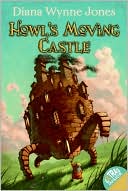
Howl's Moving Castle - This had a resurge of popularity after it was made into a movie by renowned Japanese director Hayao Miyazaki, although I admit I didn't see it (Japanese style not being much to my taste). I can vividly remember the copy that my middle school library had, especially since it spent a lot of time either at my house or that of my best friend at the time. The story focuses on Sophie, eldest (but still young) daughter of a hatter, who inadvertently insults the Witch of the Waste and gets turned into an old lady. All sorts of crazy things ensue, with a cast of characters including her two younger sisters, a dog, a scarecrow, the aforementioned witch, and of course, Howl the wizard (and his fire demon). It's an excellent story with two sequels (though I use the word loosely, as there are brand-new protagonists in each), Castle in the Air and House of Many Ways.

Chronicles of Chrestomanci - There are six books in this series (as well as assorted short stories), two of which were released in the past decade (I think I literally hugged the book and hopped up and down when I first saw one, if that tells you anything). The original four are Charmed Life, The Lives of Christopher Chant, The Magicians of Caprona, and Witch Week (which is the one I read first), while the newer two are Conrad's Fate and The Pinhoe Egg. The central concept here is the many-worlds theory, where every time a major event happens (or doesn't), a new world is split off. The book's own explanation is quite simple - "Say a continent blows up. Or it doesn't. They can't both be true, so a world splits off" and the other course of history goes running merrily along. In each series of related worlds (usually numbering 9), the people are pretty much all accounted for, so one has a bunch of doppelgangers running around. In rare cases, however, for whatever reason someone's counterparts don't exist and all the lives get concentrated in one person - a nine-lived enchanter known as Chrestomanci, who is responsible for keeping an eye on the world's magic. Got that? Good, now go explore - I've read all of these many many times and they stand up to multiple readings very well indeed.

The Tough Guide to Fantasyland - An affectionate homage and send-up of the tropes in the fantasy genre, "disguised" as a travel guide, this is an invaluable resource for the fantasy author who is trying desperately to avoid becoming a giant cliché... as well as just plain funny. With its "Official Management Terms" (like "reek of wrongness") for various overused phrases, playful tone, and generally hilarious entries, it's a must for writers and fans alike. So are the two novels that take it into story form, The Dark Lord of Derkholm and Year of the Griffin. To be fair, only the former really riffs on it (the second is a bona fide storyline sequel this time), but when you've got a package tour company from our world telling a bunch of magical creatures things they absolutely MUST have (you know, like demons) or face dire consequences, it's just fun beyond belief.

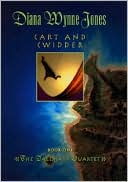
The Dalemark Quartet - This is a series that I discovered for the first time during the three-year summer, though I have no idea how I missed it when I was a kid. If read in publication order, the first two are roughly contemporaneous, the third takes place in the early, practically prehistoric days of the land of Dalemark, and the fourth, well, that jumps around a bit in time, actually... The North and South Dales are two very different places, with different customs and, well, to be honest, one of 'em isn't very nice. Morrill in Cart and Cwidder and Mitt in Drowned Ammett carry the story for the most part, with an assortment of siblings, friends, gods, and villains to spice things up. Tanaqui the Weaver takes centre stage in The Spellcoats, which purports to be a transcription of the actual woven coats. The fourth volume, The Crown of Dalemark, was published well after the rest (she did tend to do that...), and has present-day Maewen traveling into the past to take the place of a character who vanished at a really bad time...

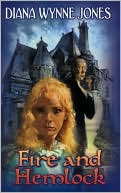
Fire and Hemlock - Having decided, more or less arbitrarily, to limit myself to five entries for each author today (hey, I know you have more to do with your life than read my rambles), I had a really hard time choosing which ones to include. I love them all! But really, I absolutely could NOT leave this one out - not least because it focuses (at least for part of the time) on something that I love so very very very much. That would be string quartets. Getting ahead of myself. Okay, so in the main this is based on the old ballads of Tam Lin and Thomas the Rhymer. Our protagonist, Polly, has two sets of memories, one with and one without Thomas Lynn in them (he's the cellist, by the way). How she works it out, how the story unfolds, and (especially) how it ends were huge topics of debate once upon a time - I've seen entire websites devoted to discussing the ending and what it all means, but rather than link you there I'm just going to say READ THE BOOK. 'Cause it's awesome.

(Note that several of her books are currently out of print in the US; however, it looks like they're reprinting many of them in March 2012.)

Eva Ibbotson (1925-2010)

Which Witch? - Still a favourite, after all these years. The wizard Arriman is getting tired of the whole "smiting and blighting" gig, and a prophecy has told of his successor - so clearly he needs a son, right? Except he doesn't even have a wife yet... Enter the witches of his hometown, Todcaster, and oh what a bunch of hags they are, too... except for the white witch Belladonna, but he can't marry a white witch, not if he wants a dark son... Yeah. It's totally fun. Chickens, bottomless pits, the obligatory evil-but-beautiful-and-oh-yeah-mysterious competitor - really, what's not to love?


The Secret of Platform 13 - There's a platform at King's Cross Station that's only open at certain times... Erm, no, not 9 3/4. At least not this time. This is Platform 13, which opens for 9 days every 9 years, and leads to a peaceful island inhabited by both magical and normal people and creatures. Disaster strikes when the young prince is kidnapped during a journey to London, and during the nine years they must wait before they can get back through to rescue him, a very unusual team hatches a very unusual plan. A giant, a fey, a wizard and a hag (just a young one) venture forth into London in search of their lost prince...


The Star of Kazan - This is one of Ibbotson's books which draws upon her childhood in Austria before the Second World war. A baby is abandoned in a church and discovered by two women, who "adopt" her and bring her home, to the house where they are servants to three eccentric professors (all siblings). As the baby grows into a girl, she befriends an elderly woman, who later leaves her a trunk of jewelry which she thought was fake... and then things get REALLY interesting. Frauds and friends and oh yeah, some pretty lovable animals too, all figure prominently in the resolution, about which I will tell you (as usual) nothing at all. Go read it yourself. :-)


Journey to the River Sea - A departure from Ibbotson's usual settings (the UK and Austria {or analogues}), this tale is set mainly in the Amazon basin in Brazil. Maia, a girl living in a British orphanage, is told that they've finally found some relatives for her to go and live with in Brazil, so off she goes, accompanied by a governess. Along the way they meet a boy actor, Clovis; her horrible twin cousins, Beatrice and Gwendolyn; and a half-British, half-Xanti boy named Finn. Set around the turn of the twentieth century, it explores racial and class prejudices as well as being a darn good book - it won the Smarties Prize in 2001 (yep, during that three-year summer).

The Great Ghost Rescue - What's a ghost to do when they're turned out of their haunting grounds? Find a human ally, of course. When the castle a family of ghosts has been haunting for ages is purchased by living humans who want to turn it into a resort, Humphrey the Horrible (who's actually quite nice) teams up with a schoolboy named Rick and some other ragtag ghosts they pick up along the way. There's politics and skulduggery and double-crosses and botched exorcisms for all to be had here, but this makes an excellent introduction to her work, not least because it was her first published novel.


Oh yeah, and if you hadn't guessed already - we're back! Summer hiatus is over and, if we've all got our acts together, you should once again see a new post up every weekday. We've mucked about a bit with the topics again, but it's the same crew of nutters you've come to know and love, so see you back here tomorrow !