Showing posts with label India. Show all posts

21 September 2011

Local flavour- how much is too much?

The other day I was reading a book set in a part of India that I knew intimately a couple of decades back. The book sucked me in from the first page, and I was happily coasting along, wallowing in nostalgia, taking note of the changes in the landscape, meeting people I had virtually grown up with. It was a wonderful ride, one which I would have been happy to have go on forever.

And then suddenly, one of the characters said something she should not have. In real life, she would have been speaking in Bengali, but translated and transposed into English the sentence constuction would have been quite different from what she was attributed as saying. At that point, the book lost me. The descriptions which had mesmerised me started looking forced, the characters I had met shrunk a dimension and became mere cardboard cut outs, and the plot which was non-existant to start with became more noticeable in its absence. I put the book aside, and may never pick it up again.


I am sure I am not the only person this has happened to. When a book is set in a place and time that you know well, you subconsiously want the descriptions to exactly match your own memories and perceptions of that point in time and space. And when it deviates from what you expect it to be, you tend to be unforgiving.

The writer, one assumes, would aware of these heightened expectations, and do her best to meet them. But is that really feasible? Local flavour is good, but only as a mild seasoning agent. Sprinkle too much of it, and you run the risk of the spices taking over the taste of the entire dish. And you end up losing all the readers who haven't yet acquired a taste for that particular time and place. Which you do not want.

How then do you strike a balance between retaining the local flavour, remaining true to type, and yet not going overboard? Can't be easy. But something every writer should reach for.

Have you ever abandoned a book, because it behaved contrary to how you expected it to? In your writing, how do you deal with it?

07 June 2011

Education for All - Falling through the Cracks


Eleven year old Kalimuddin's family migrated to the city of Kanpur to escape griding poverty in their village in North East India. Though they were willing to work hard, ragpicking was the only job which his parents could find. The family lives in makeshift housing near the garbage dumping grounds, and spends their entire day sifting through the garbage to find things that can be re-cycled. Kalimuddin's day begins at 5 am, when he is at the dumping ground going through the garbage to find anything that can be re-used, re-cycled or re-sold. At ten, Kalimuddin had never stepped into a school- there were no schools in his locality, and even if there were, he was too busy working to think of an education.

Kalimuddin was only mildly interested when an informal education center was opened in his community. What convinced him to enroll in the "Apna Skool" was the fact that the classes were being conducted in the afternoon after he ended his working day. He is now so passionate about going to school, that even after his family was forced to relocate to a different locality, he continues to cycle 4.5 miles to get to school, and even ferries other younger kids to school and back.

Nine year old Arthi is enrolled in grade 5 in the local government school in her village of Amirthapuram in Tamil Nadu. Though she is a regular student, who wants to learn, a year back, she was struggling with her classes because of the poor quality of teaching in her school. She could barely read simple words, and struggled to subtract double digit numbers. Arthi is the name behind the statistics thrown up in an independent study conducted on the state of learning in India - "While 99.5% children between 6-10 years of age attend primary school in the state of Tamil Nadu, more than 50% of them cannot read a simple story or subtract 2-digit numbers."

Arthi was one of the lucky ones. Her problem was spotted and she was enrolled in a remedial learning program. Today, not only has she mastered her numbers and letters, she helps other students learn the 247 syllables of the challenging Tamil-language alphabet.

Nine year old Anuj belongs to the Musahar (rat-eating) community, which has been officially notified as a "criminal community" by the Government. Though enrolled in a local school, he was discriminated against, and not allowed to attend classes with the 'higher caste' children. His widowed mother was contemplating pulling him, and this three siblings, out of school because she could not think beyond the squalid conditions in which the family had lived for centuries.

Anuj was lucky enough to be noticed by a school that offered him free education in their residential school in Patna. Anuj is now doing extremely well in school, and dreams of studying engineering in one of the top institutions in the country.

In theory, the Government of India guarantees the 'Right to Education' of every child. In reality, millions of children like Kalimuddin, Arthi and Anju manage to slip through the cracks for a host of reasons.

Drive through rural India, and the largest building in almost every village is the government primary school. Unfortunately, almost all these buildings are deserted, because few teachers, if any, choose to show up, and parents see no point in sending their children to schools where there are no teachers. In the evening, in the same villages, you find dozens of children crowded into tiny sheds which double up as private 'coaching classes'. Parents who can afford to do so send their children to these classes, often conducted by the teachers who employed to teach in the government schools, the rest of the children end up dropping out of the system.

Though it is illegal to do so, in both rural and urban schools, teachers discriminate on the basis of caste, creed, religion and gender. Students belonging to the lower castes are often forced to sit so far away from the teacher that they cannot hear what is being taught in class. Once these children drop out of school, it is almost impossible to get them back into the system.

The education system in India is stacked against girls. Many girls, especially in larger families, are often forced to drop out of school so they can tend to younger siblings while the mother goes out to work. Girls who escape that fate, are often forced to drop out of school after they attain puberty because most government schools lack proper sanitation facilities. Across the country, non-profits have found that the immediate effect of constructing toilet blocks is a drastic increase in female attendance, yet school buildings continue to be built without adequate facilities.

There is a large population of migrant laborers which spends six to nine months in the cities, and returns to their villages during the harvest season. Since there is little or no standardization in curriculum across schools, the children of these families are never enrolled in any school.

Is there a solution? Organizations working in the field will say there are. Is the Government listening?

31 March 2011

The End of the World

Tsunami in Japan. Revolution in Libya. Girls stoned to death in Bangladesh. Kids abused in shelter homes in India.
Cobra escaped from a New York zoo. Leopard trapped in a Mumbai drain.

You would think people could have their pick of news. But the one thing that has taken over every living, breathing moment of over a billion people for almost a week is none of those. It is something that transcends all of that. It is something that features Gods and devils. It is the End of the World. It is WAR!

Yesterday, India took on traditional rivals Pakistan in a game of cricket. Get that? A. Game. Of. Cricket. Yes, just a game. A game which is played in barely 25 countries across the world. A game!!!!

Sure, both India and Pakistan were "on a roll". Sure only one team could have made it to the Finals and have a crack at lifting the World Cup. Sure, it is the last chance for India's finest cricketer to lift the Cup. Sure, sure, sure. But....It. Is. Just. A. Game.

Offices were declaring a holiday, people were planning to wear Blue to support the team, people were going wild with facebook status updates.

But when I mentioned on my status message "Much that it may surprise you to hear it, the world is not coming to an end tomorrow!!!", people still did not get it. I wonder which part of the message was ambiguous, but I had at leat two people call me up and ask me if I was trying to reassure myself that the result of the game did not matter because I was scared that India would lose.

Surprisingly, or not so surprisingly, I had only one person back me up (and if you are reading this, you know exactly who you are)!. Everyone else chose to belive that the World was Indeed coming to an End, either way.

Like one otherwise sensible person commented, "how can u guys be so placid. This is not cricket. Cricket is when india plays with anybody else. With Pak...it is a war!!"

Wow!!!

Get real, guys. Cricket is a game. Just. A. Game. It is not War. Cannot be War. Should not be War.

It had to happen sooner or later. In fact, knowing me and my big mouth and even bigger opinions, I am surprised it did not happen earlier, much earlier. I freaked! On Facebook! On my own wall on Facebook.

This is not War. War is when you are fighting for your Values, for your Freedom, for your Land, for Riches. War is a high stakes game, where people get hurt. War is the catalyst that forces negotiations to happen. Cricket. Is. Just. A. Game.

But more than that, do the people who speak of War even realize that by bickering with Pakistan, India is pulling herself to Pakistan's level. Pakistan is still an underdeveloped Third World Country. India is spoken as one of the Political and Economic Success Stories. War with China, I can start to condone, but a war with Pakistan? Disregarding the military might of the two countries, if India takes on Pakistan, I would call it "bullying", not "War".

Anyway, India won the match (even though I am not the only one who thinks it was fixed). The World did not come to an End. The Finals against Sri Lanka will be anti-climatic. I refuse to be sucked into the Mass Delusion. Cricket is just a game, and I would rather be out running some miles, or kicking a few balls than watching a bunch of overpaid models strut about a cricket green.

Or maybe I will do something that provided me unlimited amusement during THE WAR- follow the game, not on TV or live streaming, but through Facebook Status updates. The real winners were not the Men in Blue, the real winners were the mobile service providers- they must have done more business in one evening than they did in the rest of the month put together.

And who knows, maybe the World will come to an End if India loses the next match?

And since this song refuses to refuses to go away, I am inflicting it on all of you.


Happy Non Delusional Thursday.

21 March 2011

My favourite (and not so favourite) Indian books

I am not sure if as many people have growing up reading Enid Blyton in her native England, as they have in India. Ask anyone of my age and background to name the first book they remember reading, and I am willing to bet my dog-eared copy of 'Five go off in a Caravan' that it will be an Enid Blyton book they mention. None of us had ever had bacon and eggs for breakfast and scones for tea, but all of us knew that scones were not scones unless they came with lashings of butter.

With Julian, Dick, George and Ann, and Timmy the dog as childhood companions, and Nancy Drew and Sherlock Holmes forming the logical progression, it is no wonder that I was well into my late teens when I first started reading Indian authors.

The first "Indian" author I remember reading was Salman Rushdie. Everyone, and their second cousin by marraige twice removed, had told me that 'Midnight's Children' was a MASTERPIECE, and curiosity finally got the better of me, and I checked the book out of the library. I expected brilliance, and did not get it. I lowered my expectaions, but the book still did not engage. And I finally ended up finishing the book only because I had yet to realise that my time was too precious to waste on misgotten ideals like 'you started a book, you got to finish it'.

The second "Indian" author I read was Arundhati Roy. I had fallen in love with her as the protagonist of an English language, quirky, campus movie that enjoyed unparalled success within a very select audience, and I wanted to read the book that had got the unparalled advance that it had got. 'God of Small Things, was another of those books that I finished only because I did not like not finishing books. Elegant prose if you pick a page at random and read only one page. But unbelievable characters, and a plot that I thought was non-existent. Maybe I am doing the book an injustice, but not even one scene stands out, which leads me to believe the book was entirely forgettable.

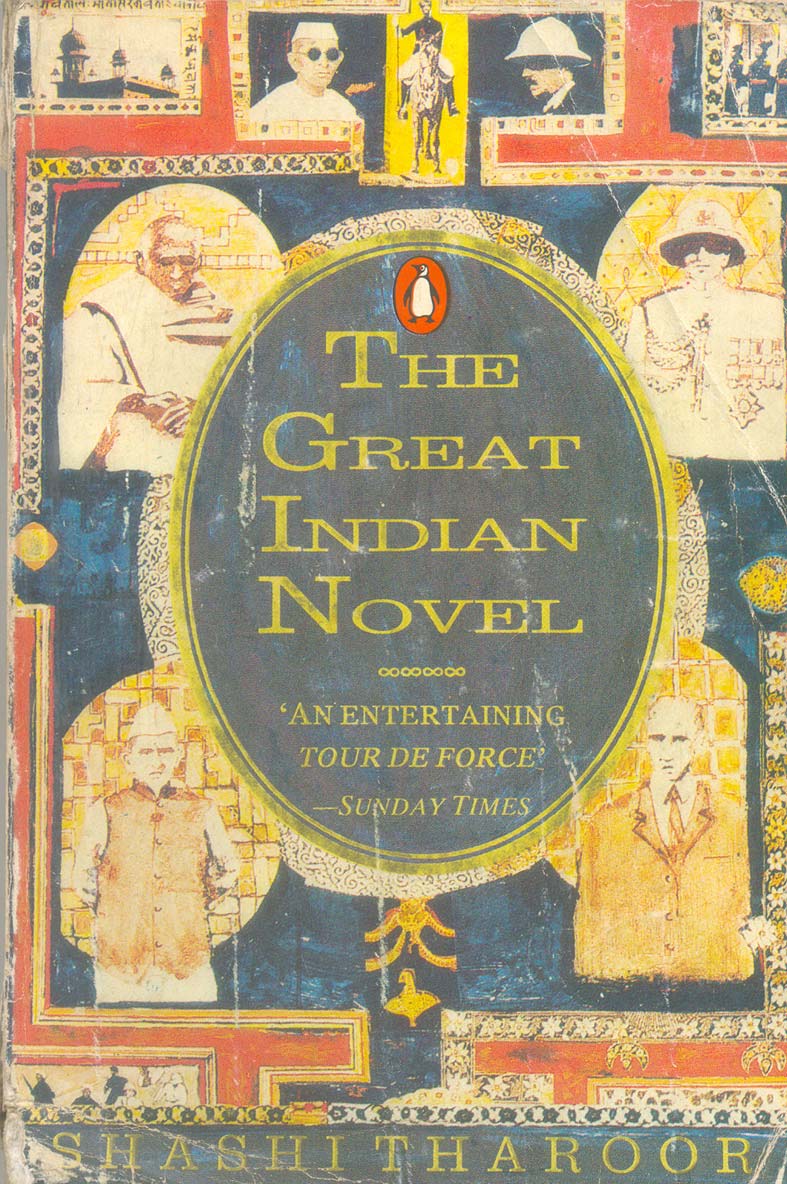
I took a decision NEVER to read any more books by Indian authors, but since I had already purchased Shashi Tharoor's 'The Great Indian Novel", I decided to make that the last book I ever read. I am glad I did. Tharoor took India's greatest mythological story and adapted it to the current political scenario. It was not the most imaginative of plots (I can think of at least two Bollywood potboilers which are based on a re-telling of the Mahabharata), and at the time when I read it, the book was at least two decades outdated. But it was Brilliant. Some references were obvious, and others were too smart for me, but there were enough obscure references which you felt good when you managed to crack. A familiarity with the original story, and a knowledge of the history of the first three decades of Indian independence is needed to make sense of the book, but it is a book I would recommend unhesitantly to anyone who knows a bit about India.

By now, I could see the pattern emerging. For a book written by an Indian in English to be popular, it seemed necessary to have a very strong mystical, exotic and/ or poverty striken angle to it. But was that really India? Wasn't India a lot more complex than just that? Shouldn't books written by Indians and set in India deal with issues that occupied mind-space in India?

Shashi Tharoor gave me that book. 'Riot' is the story of a small Indian town torn by religious violence told from multiple perspectives. In hindsight, the protagonists were almost predictable- the do-gooder American wanting to discover India, and doing so insite the pants of a seemingly upright civil servant. The Hindu and the Muslim. The fundamentalist, and the seculars. The perpecturators and the victims. But what I loved about the book was the way the author portrayed 'reality' from each of their perspectives. It was a book that I ended up recommending to many people, less for the literary merits of the book and more for the balanced picture it painted of the country.

After Riot, I decided to read "Indian" authors without thinking of them as "Indian" authors. I expected nothing more or less than a decent story, well written from them. If the characters and situations seemed familiar, I would be happy. If they did not sound familiar, I would just pretend they belonged to a foreign setting. The book I read immediately after taking that decision was the book which I still consider one of the best books I have ever read.

Vikram Seth hit the headlines when I was a teenager because of "The Golden Gate", the novel written entirely in sonnets. Much as I was captivated by the novelty, I knew better than to attempt reading the book. Instead, I waited for 'A Suitable Boy' to lose my Seth virginity to. And a better book I could not have chosen. Characters I could relate to, circumstances that sounded so familiar I could have lived them myself, believable story line, great storytelling. What's not to adore? And the best part of 'A Suitable Boy' was the fact that in an absolutely non-pedagogical manner, the author was giving me nuggets about my country that I had not even suspected existed. Most people comment on the length of the book - not me. I would not want a single paragraph from that book deleted.

After that there was a whole bunch of books that I sort of liked (The White Tiger, Q&A, The Village by the Sea) even with being aware of their shortcomings, another bunch of books that I refused to finish (The Inheritance of Loss, Calcutta Chromosome), and a very large bunch of books that I refused even to pick up. One book, and only one book, stands apart from that lot.

Rohinton Mistry's "A Fine Balance", was a book I picked up, strangely, because Cruella asked me if I had read it, and what I thought of it if I had read it. It had been a book I had been intending to read for a very long time, but which needed a catalyst to actually get me reading. And I am glad I did. Set in a particularly unsavourable period of recent Indian history, it is the story of four characters I have never met, and would never meet. The book got me thinking like few works of fiction have- it tied together all those assorted conversations which I had with various people, and from which I missed the core point. It made me start reflecting on the real cause of India's ills, and led me, many months and many conversations later, to hone in on what I now believe is the thing we most need to change in our society.  I am not sure if everyone who reads the book will take-away what I did from it, but even otherwise, it is a book worth reading, if only for a story well told.

I could perhaps go on much longer with my opinions on "Indian" books, but that can be kept for Part 2.

15 February 2011

Topical Tuesday- the Curious Case of the Red Rash Epidemic

As those of you who have been following this blog know, Tuesday is the day when we blog about something "Topical". And in mid-February, what can be more topical than Valentine's Day? You start seeing the first signs of it towards the end of January, when shops start developing a bright red rash on their windows. It starts out small, but pretty soon assumes epidemic proportions. Till recently stores selling plumbing supplies were immune, but they are also starting to lose their immunity- who are the people who buy tiles with patterns of interlocked hearts for their bathrooms?

But what is Valentine's Day? This is what Wikipedia, my one stop shop for pop-information has to say-
Saint Valentine's Day, commonly shortened to Valentine's Day, is an annual commemoration held on February 14 celebrating love and affection between intimate companions. The day is named after one or more early Christianmartyrs, Saint Valentine, and was established by Pope Gelasius I in 496 AD......It is traditionally a day on which lovers express their love for each other by presenting flowers, offering confectionery, and sending greeting cards (known as "valentines").

No matter how hard I try, I can't seem to find any well documented, authentic link (except the name) between the early Christian martyrs and "affection between intimate companions". Even though I have a healty imagination, I am just not able to picture one of those early martyrs complete with pained expressions and arrows sticking out their back declaring their eternal love for an "intimate companion" while waiting to be beheaded. Let's just assume the usage of the name, Valentine, is purely coincidential and unintended. Which makes Valentine's Day probably the only truely non-religious, global holiday.

Since all it calls for is an "intimate companion" and "love and affection" to declare towards the said "intimate companion", the holiday transcends religion, gender, age and geography. Anybody can celebrate Valentine's Day. Everybody does.
Everybody, that is, who is young, in the grips of nascent love, and dreaming of converting those covert glances into something more.

And nowhere is the festival celebrated with greater enthusiasm than in India. A country which is still in the process of emerging from the prudishness imposed on it by the prissy Empress Victoria. A country where even two decades back it was considered almost scandalous for a couple to know each other before marriage. A country where "convincing your parents" that you wanted to marry someone was much tougher than actually finding the person you wanted to marry.

That same India has now embraced Valentine's Day (and Rose Day, and Friendship Day, and A-Dozen-Other-Such Days) and made it it's own.
Valentine's Day is when you send a musical card to that cute guy you have been looking at for nine months, to get him to spend the rest of his life looking at you.
Valentine's Day is when you gift a heart shaped cushion to the girl you have been going out with for two years, before telling her that you would like to take her home to meet "Mother".
Valentine's Day is when you send red roses to your "intended", so the recipient knows that she/ he is indeed still loved [sometimes I wonder if a guy will even know it if his girlfriend replces the tag and sends the same bunch of flowers back to him- or does that defeat the purpose of romantic love?]

Clearly, all of that is grossly immoral and contrary to the grand modern traditions of Indian prudishness. So instead of digging wells, construting schools and building roads, what do the political parties do? They denounce Valentine's Day as the Secret Weapon that "the West" is using to undermine Indian culture and break the nation apart. Stores are preventing from stocking Valentine cards, florists are forced to down their shutters and couple who dare [gulp] hold hands in public are tarred and stoned.

Serves a dual purpose. The obvious one is that attention is deflected from the fact that real problems are not being solved, to the fact that Indians are daring to express their love in public. But the other objective though less overt is the real one. India has a rich tradition of sensuality (and sexuality). Centruries before the birth of the Watery Tart, ancient Hindu Goddesses had declared war on Clothes. If temple sculptures are to be believed, they wore little more than a flimsy piece of loosely cloth draped around the waist. What they did adorn themselves with, however, was jewellary.

And that's what the Modern Indian Woman is now demanding from her husband. That he gift her Diamonds on Valentine's Day to prove that his love is indeed true. Obviously, the diamond lobby is much stronger than the paper heart one.


Random aside- why is a so called "heart" shaped the way it is, when a real heart looks nothing like it? And what does the heart have to do with love anyway- isn't it all hormones?

I am not too sure if any of the Burrowers celebrated Valentine's Day (Chary may well be the only exception), but that doesn't mean you would not enjoy the Valentine Feature at the Burrow. A drabble (or more) a day, everyday on the many facets of Love.

04 January 2011

Burqa Sales on the Rise

On the First Day of the New Decade, the first thing I read were these headlines on the front page of the newspaper - Burqa sale on the rise in Old City


Though I try to deny her existance, there is a dormant feminist in me, who reacted immediately, and adversely. And we try to delude ourselves that the nation is progressing, while what we are actually doing is regressing back to the Medivial Ages. Grrrrr, grrrrr, grrrrr [insert picture of snarling cat, clawing through the computer screen].

The first paragraph of the article only confirmed my reaction -
The Shahran market near Charminar has undergone a curious change in the last few years. A string of new shops that have surfaced in this bazar sell only burqas. From 20-odd shops in 2002, there are 80 burqa stores here and traders say business was never so good.
In what appears to be a reality check on the perception that women are stepping out of the burqa in Hyderabad, traders say that an increasing number of women, most of them young girls, are choosing to don the garment......
To say I was disappointed was an understatement. There is a government-run school in my neighbourhood, and I always felt good seeing the number of Muslim girls from lower income households attending that school. In fact, I always thought it ironical that in the more conservative lower-income Muslim families, the girls ended up getting a better education than the boys, simply because their families did not want to spend money to send them to the Islamic madrassas.

I always hoped that the generation of Muslim girls getting a good education would bring about a change in the mindset of the community, which would enable the economically backward community enter the social and economic mainstream of the nation. With better education leading to better job opportunities, Muslim youth would not longer be lured by the cheap promises of people supposedly fighting for the religion. In a generation, or a generation and a half, I dared hope for a natural end to terrorism and communal violence.

But here was proof that I was living in foolish daydream of my own construction. "The sale of burqas have never been as good". The words gnawed at my heart- could the year have started off on a worse note than by dashing one of my dreams? I was tempted to chuck the newspaper across the room, and think more positive thoughts.


But my eyes are conditioned to read, even if the brain tells them not to. I read on-
While they say the reasons for this trend range from religious beliefs to some even trying to make a fashion statement, social observers say the improving sales of burqa are rooted in a radical change that the Old City is undergoing - an increasing emphasis on the education of girl child.

Things started falling into place. How did I know that there were so many Muslim girls attending the school near my place? Simply because their heads were covered. And if their heads were covered, they presumably bought their veils somewhere, and naturally that meant increased sales.

Suddenly the statistics started looking good. If the number of shops selling burqas has gone up four time, that means there are at least four times more girls stepping out of the house than there were a decade back. Which means a larger number of girls going in for higher studies, and taking up jobs outside the home. Which means social change on a scale that one cannot otherwise contemplate.


By just looking deeper, the first article I read in the new Decade metamorphosised from one of abject despair to one of great hope.

A feminist may still question why society should decree that a girl be veiled. A feminist would definitely try to get the veiled girl to shed the veil. But I am not a feminist. To me, it is enough that girls are stepping out of the home and getting an education. A veil matters much less than your attitude.

And educated, empowered girl will raise a healthier, happier family than her less educated mother, and enough of them will bring about real change.

There is Hope still.

24 December 2010

When should the Tree go up?

Some of you are aware of my misadventures with the Christmas tree, but for those who came in late.....

Last week, after watching the kids decorate the tree, I had just turned on the lights, and stepped back to admire the sight, when my younger one went to take a closer look at the ornament and managed to knock the whole tree over. Two days later, when I was rushing to drop the kids off to the school-bus, he managed a repeat performance all over again, causing me to blow my top off, before banishing the tree to a corner where it just could not be reached.


Part of the reason why the tree came down twice in two days is my (nearly) five year old son. I have been hearing all of you go on about the adventures of your cats, but trust me, Thing Two can be more destructive than Bella, Angel, Callie and Flower put together. But TT (Thing Two, not Thursday Twin) is not the only reason for the tree toppling over so often- the main reason is that I did not store the tree too well the year before last, and the base got dented and made the whole tree really wobbly.

Last year, I promised to get the kids a new tree, and in the second week of December, I finally went to the market to keep that promise. Guess what I found - lots of thinsel, and plastic candy canes, and Santa hats, but no trees. Yes, you heard it right- not one single tree over two feet in height was to be found ANYWHERE in the ENTIRE market.
"Come back next week", they told me politely. "We will definitely have bigger trees then."
"But Christmas is in ten days", I sighed.
"Yes, Madam. Christmas is on Saturday. After that, you will get many trees. Many varieties of trees."
"But I need a tree before Christmas. Not after it", I said. "What will I do with a tree after Christmas."
"But, Madam, everyone buys a tree after Christmas", he explained patiently.
"Where will I put my Christmas presents if I don't have a tree?", I wailed.
By then he must have thought I was a certified nutcase. "Come back next week, Madam. You will find many trees", he said before turning his back on me.

Ridiculous though it may sound, in India, the official date for unveiling the Christmas tree at home is December 25th. Hotels and malls take down the Diwali decorations in the last week of November and replace it with Christmas decorations, but houses wait till Christmas to put up the tree up.

In a way, it does make sense. Christmas is not really a 'festival' for most Indians. It is a tradition that we have picked up along the line, and incorporated into our own. In India, we need an excuse to party- Diwali is one such excuse, the one immediately after is the New Year. When you throw a Diwali party, you decorate the house with candles, marigold flowers and floor patterns. When you throw a New Year Party, you have a tree.

Since New Year Parties typically happen on December 31, there is really no reason why the tree should be up before December 25, is there?

So, if I want to avoid tree toppling incidents next year, I would be wise to brave the crowds tomorrow and get myself a new tree.

Merry Christmas!!!!