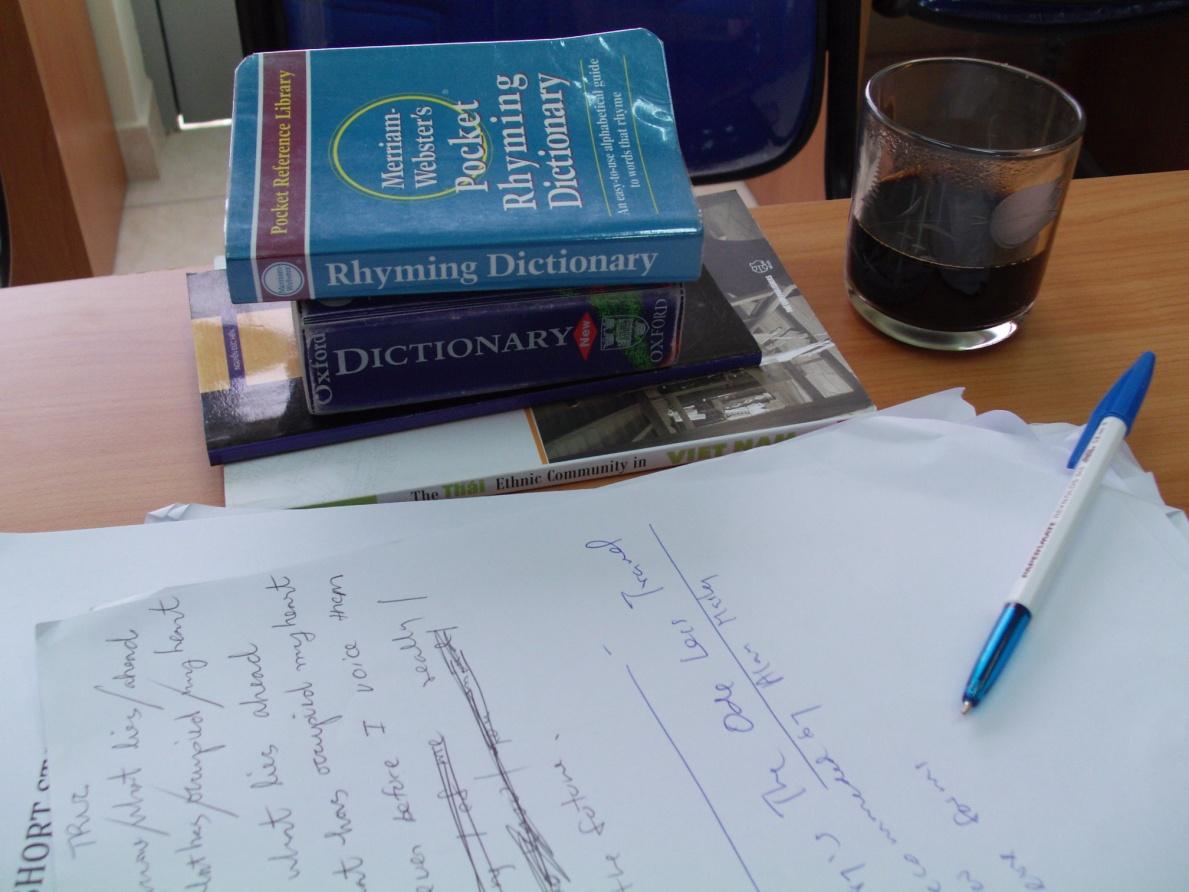
So nobody is surprised to hear I'm insane... I know that... but I am committed to NaNoWriMo in November. I've successfully completed TWO WriMos (one NaNoWriMo and then BuNoWriMo in June) so I am not SUPER freaked (except about the bear Mr. Tart becomes when I go under—that part is no fun). But both of the books I completed in WriMos STILL are sitting with a bunch of holes in them... (Oh, I have other books sitting with holes, BUT...)
*cough *
My point is, I'd rather finish THIS ONE without a bunch of holes... (well, holes are okay, but not HOLES) So I thought I'd make a PLAN!!!
And the NICE thing is, since my last WriMo, I tried something... and it WORKED! What's more, I used it to write a MYSTERY and my WriMo idea is ALSO a MYSTERY (did you hear the cha*ching?).
So what IS this NEFARIOUS PLAN?
I am STORYBOARDING!!!
[This was the last one; isn't it pertiful!?] each square is a DAY and each column within the squares are separate chapters... it seemed to work for the pacing... about three new pieces of info a chapter... I am currently trying to incorporate feedback from my readers on the edited draft, and they seem to be mostly pleased... So what about for the WriMo?
Storyboarding Prep
For a mystery, we need to KNOW a couple things before we begin.
The things I have already worked out are these:
-Who dies?
-Who SOLVES IT (and who are her primary helpers?)
-Who are the suspects?
-What is the MOTIVE of each suspect? (yes, they all get a motive... it would be rude to make them suspects, otherwise).
What I want to work out BEFORE storyboarding and writing that I HAVEN'T yet worked out... (hey, I have a week)
-The CLUES that the sleuth needs that POINT TO the suspects and motives.
-Elegant CONNECTIONS between suspects (and the murder victim) and clues so that there REALLY are only about 3 loops of what might have happened, even if a few of those loops are associated with a couple different suspects. It gets too confusing if there are separate strands for each suspect, and it is too trite if there is basically ONE motive that all the suspects share.
Once THESE are set, I write my clues (with who reveals them to whom or how they are discovered) on POST-IT NOTES!
SQUEEEEEEEE!
They are multicolored—and pretty (see?), and I even have a rainbow set of sharpies to use with them!
So that is my plan...
How about the rest of you? Any more WriMos? Anyone have a PLAN?
Showing posts with label Writing Tuesday. Show all posts
26 October 2010
19 October 2010
Writing Tuesdays: Novel Writing Strategies and Links
I have found that I am a methodical writer. I need time frames, outlines, charts, graphs and most of all - a nice hot cup of coffee with two creams and four sugars. Not everyone is like this, I know. Many of my students are not like this. They are "spur of the moment" writers. My students are very much the latter but need some of the former.
Last week, I gave an assignment for a prompted journal writing session. I gave the students the prompt, "When I look out the window I see . . . I hear . . . I feel . . ." The lesson focused around imagery and descriptive language. Some students wrote about the scaffolding around the school and how it makes them feel closed in while listening to the disruptive construction workers outside. Other students wrote about the skyscrapers and how they were reminded of the affluent residents of the neighborhood while listening to the sirens of the police cars, fire trucks and ambulances. Yet one student spoke of how she saw a sea of opportunity, the hopes of acquiring the "American Dream" and listened to the beat of the city that would feed her dreams one day. These were stories that were worthy of their own novels.
Unfortunately, many of the stories lacked descriptive language. Granted, many of my students lack the skills to write an effectively rich story due to deficiencies in syntax, grammar and a good command of the English language. But these same students have a creativity that leaves me flabbergasted most days. Many of them left last week, with a better understanding of one of the principles of becoming a good reader and writer. They also taught me something, too - take something small and expand it to make it big.
Like I said, I need structure as do most of my students. So I turned to some of the following sites to get some ideas:

The Snowflake Method- http://www.advancedfictionwriting.com/art/snowflake.php
This method is good for those of us who need to break up a large project into manageable pieces. The shapes are significant in that each polygon, from triangle to snowflake, has a designated writing element assigned to each vertex. It then delineates essential steps in the writing process that assures people, like me, some structure to their writing. This site has tips for the novice to the expert writer.
Novel Writing for Beginners - http://www.writerswrite.com/journal/sept97/keegan.htm
This next link is wonderful for those who have not been published, who have the beginnings of a novel or just need help in getting started. This site discusses writing in manageable chunks by beginning with short stories and then lengthening your writing over time. Please do not misunderstand the title. The author of this article simply wants people not to become discouraged by attempting to write at the level of Stephen King or J. R. R. Tolkien with their first novel. Not that no one can write at this level of expertise! I am pretty sure there are many who can.
For the novel writer who is in revision, here are some tips - http://www.writersdigest.com/article/4-steps-to-take-your-novel-to-the-finish-line/
I am not at this level but I am sure there is someone out there who is. *winks at the Naked Tart* I found these four simple tips to be really invaluable. I discovered that the tip, "Identify lulls in action where you can insert mini-scenes," to be really helpful. Take a look and try some of these strategies.
Where are you as a writer? What are some helpful tips that would facilitate the writing process? Inquiring minds want to know.
All images taken from Wikimedia Commons
12 October 2010
The Lost Art of Letter Writing

You're probably reading this post on a computer screen, right? Maybe a smartphone? But when's the last time you read an honest-to-goodness letter? One that someone sat down and wrote to you, then put in an envelope and mailed?
Now, when's the last time you wrote a letter?
*crickets chirping*
Uh huh, I thought so.
I'm not much better - I've written three cards in the last few months; those were tucked into packages, but the last real on-paper handwritten stamped-and-sealed (and not-in-a-package) letter I sent was probably a good four years ago. It's all email and IMs and Twitter and Facebook now, and though I admit I'm all over the outer two (I turned off the IM 'cause I really couldn't get anything done with that on... *ADD*), and it's fun to go back and forth in short little bursts like a conversation, sometimes I still miss the narrative of a good letter.
A bit of ancient history...
Like many kids, I went to camp far away from home, at least starting when I was 14. Being older than I look *cough* email wasn't really a viable option for keeping in touch with my friends back then when I was wandering around in California or British Columbia or Maine, or with the buddies I'd met there once I got back to Massachusetts. Soooo... we wrote letters. Back and forth, crisscrossing the continent, sharing news and random info and (in one notable instance) tufts of cat fur, as I was missing my kitties and a friend sent me some fluff (speaking of whom, Happy Birthday, Katie!). I kept in touch with my camp buddies for years this way, and in fact two of us managed to reunite at college 4 years later (and another one landed at Brown with Katie, come to think of it).
Where am I going with this?
Hands up, who's read The Guernsey Literary and Potato Peel Pie Society? How about Lady Susan? I love epistolary novels - characters know only as much as they reveal to each other, and we learn about things in "real time", as it were. A clever author can make each different writer have a distinct voice, even without endearing misspellings or turns of phrase to distinguish one from the other, and it's great fun to read between the lines or compare a character's telling of the same event to two different correspondents.
Now. Who's read ttyl? Or Entrapment? Somehow, IMs, texts and Tweets don't quite do it the same way for me - it's like an endless stream of dialogue, and we all know that's never a good thing ("show, don't tell", eh? {Besides, Entrapment is totally Cosi fan tutte all modernized, which is really mindwarping...}). Aside from the fact that it's a lot harder to distinguish personality (or even education) when you're looking at lines like "OMG show me 2mrw" (wow, that hurt), you don't get the chance to sink into any one character's personality or mindset before you're abruptly bounced into the next... and the next, and the next.
Erm, you know...
Yes, I do know. I'm a terrible snob, a Luddite, a backwards-looking slow-adapting left-behind. But try this experiment. Slow down. Think about how you'd tell an old friend about the latest news in your life. Now actually write the letter. Maybe you mail it, maybe you don't... but if you do, there will be a very pleased (and probably very surprised) recipient who just might write back. And you will have completed quite a nice little writing exercise.
I do get to the point eventually, y'know. :-)
Image: Public domain
05 October 2010
Drabbles
| A Story told in Two Words |
The term apparently comes from Monty Python's 1971 Big Red Book, where "Drabble" was a word game where the first participant to write a novel wins. In order to make the game possible in the real world, it was agreed that 100 words would suffice to tell a story.
Purists have questioned it. According to them, a story can be called a story only if it has detailed plots, meaningful character development, and an easily identifiable beginning, middle and end. I am no expert on what constitutes or doesn't constitute a story, but take a look at this one-
High school sweethearts, we drifted apart. Corporate lawyers need trophy wives, not gynecologist-wives on call twenty-four hours. Neither noticed when we stopped exchanging X-mas cards. Keeping in touch was tough before e-mail.
You found me on Facebook. I accepted your friend request. We had grown as people, but the old spark was still alive. You wrangled a trip to the Continent, I drove down to Paris. We were lovers again, though never to be re-united.
Your wife is Catholic, she will not let you go. My husband has Alzheimer's, I cannot leave him. Only in Paris can we be Us.
Plot? I can think of dozens of published books where the plot is not very much more complicated than this.
![]() |
| Character sketch |
Beginning, Middle and End? Maybe not. The middle ages have merely been indicated, but is that central to the story? Had, for instance, Eric Segal had written the story, over half the book would have been devoted to the lives that the main characters led when they were separated from each other. A literary writer may have written it from the standpoint of the lady dealing with her husband's Alzheimer's. Chick lit would have contrived a happy ending somehow. But, no matter how you choose to deal with the topic, the story told in 100 words, does tell a story.
Or take a look at this one-
I found out all about her. She had grown up in this village. Left in disgrace after being impregnated by an infidel. She returned with her gypsy lover– she flaunted him.
She was everything I hated. I denounced her from the pulpit. Predicted eternal hell for her offspring.
She said love was not a sin, hate was. She remained unrepentant; she continued to attend my church.
She asked for me before she died.
"Father", she confessed. "You are my first-born child."
She died. I have to go on living. How?
People who live in glass houses... should not throw stones.
I had just finished reading Joanne Harris' Chocolat when I wrote this, and everytime I read the drabble, I am taken back to the other book. The details are merely indicated, but any reader can fill them in. It can easily be expanded into an entire novel, without needing to add anything.
A hundred words can never convey as much as a 75,000 word novel, not is it expected to. One is an oil painting, the other is a pencil sketch- the two cannot be compared.
Why go into all this? Because I do think that writing a drabble is one of the best writing exercises there can be. Any writer will tell you that the key to writing is to write everyday. But there are days when real life catches up with you to such an extent, you just cannot find the time to write. Drabbles are ideal for those days.
You can think about the drabble while your hands are otherwise employed. You can play it out in your mind, to determine what is absolutely essential and what can be taken out. The physical act of writing down the drabble need not take more than 15 minutes. Add another 15 minutes to edit, add, chop, and change to make it 100 words, and you have a drabble. While a self-imposed discipline of 1,000 words a day may take you closer to having the first draft of your manuscript in three months, writing a drabble a day gives you as much writing practice as writing ten times as many words.
Try it. It can be addictive.
And to get you started, do check out some of the drabbles on our home website- the Burrow
A hundred words can never convey as much as a 75,000 word novel, not is it expected to. One is an oil painting, the other is a pencil sketch- the two cannot be compared.
![]() |
| Write EVERYDAY |
You can think about the drabble while your hands are otherwise employed. You can play it out in your mind, to determine what is absolutely essential and what can be taken out. The physical act of writing down the drabble need not take more than 15 minutes. Add another 15 minutes to edit, add, chop, and change to make it 100 words, and you have a drabble. While a self-imposed discipline of 1,000 words a day may take you closer to having the first draft of your manuscript in three months, writing a drabble a day gives you as much writing practice as writing ten times as many words.
Try it. It can be addictive.
And to get you started, do check out some of the drabbles on our home website- the Burrow
28 September 2010
The Johari Window and Character Development
One of the more tangible things I have done as a student (not that the rest of it isn’t useful, but you know – it tends to get very theoretical) was my one semester with “work related, project centered, intern-ish” studies. Escaping the abstract academia one semester, I had the opportunity to do out-in-the-field research with a group of other students, and in the process we got a taste of what life working in a large government agency would be like (glorious! At least compared to our student standards… Did you know they serve hot dogs in the cafeteria on Fridays?!). The semester also included lessons on topics such as how to write a job application; or communication within work teams. All very useful things to bring with me for whenever I finally finish my master’s degree (which should be soon. Just keep swimming…).
One of the things that I didn’t see the immediate value of learning, though, was a little something called a Johari Window. It is a cognitive psychological tool created by Joseph Luft and Harry Ingham in 1955 (Joseph + Harry = Johari. Cute, huh? They named their brainchild after themselves). I think the purpose in my class was to teach us how to improve communication within our teams, since the Johari Window traditionally has been used as a means of understanding interpersonal communication and relationships.
The window is a simple grid with four main “rooms”: arena; blind spot; façade; and unknown:
| | What I see | What I don’t see |
| What others see | Arena | Blind Spot |
| What others don’t see | Façade | Unknown |
When used as intended you are supposed to choose a given number of adjectives from a list that can be found here (or a darker version with negative words – the Nohari window [I can’t help but wonder – who is N? Did Harry cheat?]) that you feel describe you. Then, someone else (your peers) choose the same number of adjectives from the same list. The words overlapping will go into the room “Arena”, because these are qualities that both your peers and you are aware of. If your peers have mentioned traits that you have not, these go into the “Blind Spot”. If you have chosen traits that your peers have not, these go into “Façade”, which describes things you are aware of that your peers don't see. Finally, the remainder of adjectives, whether they remain unused because they don’t apply to you or because you or your peers are not aware that they do, go into the “Unknown” category.
To me it was never all that clear why this should help our in-team communication (in theory I get it, but in reality it only made for some raised eyebrows and unvoiced “so you don’t think I am dignified?”-accusations). What I immediately recognized this as useful for, though, was character development in fiction writing.
In fiction it is essential to create interesting characters. One way of adding extra dimensions to your characters is to allow layers. Perhaps they aren’t everything they pretend to be. Perhaps they are more? Imagine a whodunit with the following character:
| Tom Killer (TK) | What TK sees | What TK doesn’t see |
| What others see | Calm Able Organised | Trustworthy Needy |
| What others don’t see | Ingenious Violent Intolerant | ? |
By the way, I cheated a little. Since I’m using this as a fictional character development tool rather than an analysis of a real person, I figured it would be more interesting if I used traits from both the Johari and the Nohari variety.
The traits that Tom recognizes in himself, and the ones he chooses to display outwards, are radically different from those he does not see (falsely or correctly perceived by others), and from those so deeply hidden that no one can see them.
One benefit of doing this exercise in a fictional environment as opposed to a real-life one is that the “Unknown” category doesn’t have to be unknown. The character or any of his peers might not see these traits, but the author/narrator/reader might:
| Tom Killer (TK) | What TK sees | What TK doesn’t see |
| What others see | Calm Able Organised | Trustworthy Needy |
| What others don’t see | Ingenious Violent Intolerant | Cynical Self-conscious Insecure |
If you look at the first room separately, Tom isn't necessarily such an interesting character. He presents himself as a calm, able and organized man. If you add the traits he is hiding behind his façade, however, you are immediately triggered. What sort of man is this who appears to be calm, but underneath he is violent? If you further add that he can appear both trustworthy and needy, but that he is not aware of either of these traits, he begins to look like a complex type. The final room in this case gives an indication of why he is like this.
Further – what others see isn’t one thing – different people see different things. In Tom’s life there are a number of people. Perhaps he has a brother, Noel Killer. Noel knows his brother better than most people, so the Arena and Blind Spot areas of the Tom/Noel window will be radically different than that of Tom/Barry the Milkman:
| TK/NK | What TK sees | What TK doesn’t see | | TK/BtM | What TK sees | What TK doesn’t see |
| What NK sees | Calm Able Organised | Needy Insecure | | What BtM sees | Calm | Trustworthy |
| What NK doesn’t see | Ingenious Violent Intolerant | Cynical Self-conscious | | What BtM doesn’t see | Ingenious Violent Intolerant Able Organised | Cynical Self-conscious Insecure Needy |
To make this a little easier I reused the same traits for all the grids. But there is no rule saying that you have to. Barry the Milkman might be absolutely convinced that Tom is idealistic or shy or even witty even if no one else (including Tom himself) sees this. This way, the Johari Window not only can be used to make complex characters, but also character relationships (which, incidentally, is another important aspect in making your characters more interesting).
Creating a fascinating fictional character doesn't have to be more difficult than this!
Who says my six years as a student at the university hasn't paid off?
~~~~~~~~~~~~~~~~~~~~~~~~~~~
Speaking of the university... I am (as many of you will already know) in the process of finishing my master's degree. In an attempt to avoid blood pressure levels of a BP executive, I have asked my fellow Burrowers to excuse me from blog duties the next two months. Thus, this will be my last post here for a while. I will still post at my regular blog, The Giraffability of Digressions, and I will return here as soon as my offline life allows it. In the meantime I know that this blog will be filled with clever, witty, useful, entertaining and resourceful posts.
Aaand speaking of clever, witty, useful, entertaining and resourceful posts... If you want more tips on character development, I suggest you check out last week's initiative hosted by Alex, Elana and Jennifer. They carried out an experiment where they invited people from all around the blogosphere to give their insight on one common theme: how to create a compelling character? The response was overwhelming - close to 200 bloggers offered their thoughts on this matter. The list of all the participants can be found here, and I highly recommend you check it out!
With that note I'll have to say goodbye for now - looking forward to coming back (as a free woman, at last).
21 September 2010
The In Between
Since Tuesday is our writing blog, you may wonder what the heck I'm talking about, but I suppose if you knew right off the bat, there would be no point typing up a blog post on the matter, eh? I mean what I mean in two contexts, and they take a slightly different shapes. Let me e'splain...
I call this stewing. I probably should call it fermenting, but frankly I hope I am simmering OFF the giddy drunkenness and bringing my 'out there' idea into a transmittable story... erm... it's not usually a plot... usually it is more of a set-up... that comes first. The best of my ideas need to stew about six months to really be ready to play with, and the VERY best stew six months only to meet up with a couple freshly inebriated ideas so that it has both structure AND whimsy.
Here are some examples of that early SET-UP:
Book 1 (CONFLUENCE): what if I lived in one of these houses that backs up to the woods, and there was a homeless guy living in them... what if he made friends with my DAUGHTER? (then age 5)
Book 2 (which turned out to be book 3, but never mind... part of a trilogy): What if I moved into a house and there were CHILDREN hiding in the attic because somehow their parents had disappeared?
Book 5 (DENIABILITY): What if there were an organization charged with making sure the secret service was paranoid?
Now those ideas are a little intriguing... you might SEE how they caught me. But what the heck do you DO with them? I've tried to force stories, and they end up canned. The characters are two-dimensional and I don't do them service. If, however, I let the idea work its way around my brain for a while, pretty soon the characters take shape... then I can write a scene and get a feel for their personality... then another of those odd ideas will come to me and FINALLY I am ready to write.
I am a solid believer that books don't get written because we are INSPIRED, but because we PERSIST. However, I ALSO believe you shouldn't write it until it is ready to be written--until you can get the bones of the plot down and a list of primary characters. When I started writing seriously, I wrote fan fiction in the in-between--I was writing... just not what I eventually WANTED to write. NOW, I have enough books written but not polished, that I EDIT in the in between {I will NEVER be caught up with editing... the idea always gets ready BEFORE I make a significant dent in my editing pile and HAS since I started that second book I finished (though there is a half-done book between one and two that got abandoned when that other idea finally stopped letting me be}).
So there we have the writing in between... for ME, a necessity.
The Editing In Between
This is about space and distance. If I can set something aside after the first draft is done, I will know I have transcended my human failings. But after first edit, THEN I try to set it aside for a little while. IDEALLY, I do a few critiques for OTHER people, so that I can pull myself far enough out of my story that my eyes don't automatically correct... that my BRAIN doesn't fill in what SHOULD be more explicitly said.
I've managed this, even on deadline, with my Cozy by taking the time to scan for just the main ideas by section, and write them down, and now I am READING it. Yes, I have a pen in my hand (I have not quite managed not editing as I go), but I am TRYING not to edit. I am using post-its to mark pages, and writing in margins things like 'good time to hint at...' and 'were they still fighting?' so I'm reading and note taking, not changing words (erm... if I was doing what I meant to be doing... that's what I'm TRYING to do).
And you know what HAPPENED when I did what I was SUPPOSED TO last week?! A twist on my ending that has repercussions through the story (will get me up to my word goal) and makes the whole thing just a bit more clever occurred to me... because I was ONLY READING, not editing. I needed to be far enough back, and moving through fast enough, to spot the twist that would make it better.
So that is this week's writing advice... allow yourself to take advantage of what happens in between
Permission for Antelope Canyon Picture
14 September 2010
Writing Rites, or a Right Way to Write?
Ah, rituals. They can give order to our lives, or hamstring the crap out of 'em. There are those that swear by them, those that refute them, and those that sort of look at them askance while backing away slowly.
When it comes to writers, it seems we're a rather superstitious bunch - I've read about writers who can't start unless they have a certain number of pencils at the ready, those who clear their desk of everything except the computer before starting, and of course the ones who swear by coffee shops are among the most visible out in the wider world. Googling "writing rituals" gets you upward of 281,000 hits. There are probably at least as many rituals as there are writers, but no clear consensus on the rights and wrongs of the matter. Clearly, however, they are a big deal. Me? Errrrm...
Well, to be honest, as with most things in my life, it's a bit of a mad scramble. When it comes to those things I churn out in a typed format, I'm usually flopped on my bed with
my laptop. There's frequently a kitty or two curled up on or next to me, and generally speaking, if I'm typing, there's a deadline (this blog, for example, or a WriMo). However, the computer has a major drawback, which I'm sure you've all spotted already - that's right, it has internet access! While this can sometimes be a bonus - I've just come from the Wikipedia page for Scottish Gaelic, for example, doing a little bit of "research lite" - mostly it's a distraction. Oops.
So if it's such a distraction, how do I get anything done? Ah, well, that's where the notebook comes in. If you read my last Writing Tuesday post (about handwriting vs. typing), you've probably already guessed where I'm going with this next bit too - namely, that when I really want to get something hashed out, I grab a notebook and a pencil (a mechanical pencil, mind - no sharpeners needed) and leave the house. Sometimes I pop down to the nearest coffee shop and feed my caffeine addiction while roughing out the next story point; sometimes I head in the opposite direction, to the cemetery, where I curl up under a tree and get down to business; this week, it was over to the Arboretum to rhyme up a storm for a picture book project one of my oldest friends dreamt up for us.
My first successful WriMo had some serious rituals to it -
I'd get home from teaching around 9 PM, make a mug of hot chocolate and grab a pack of tuna jerky (yes, I'm serious. There is tuna jerky. It's not bad, either), then park my butt in my desk chair and pound away until midnight, at which point I'd write down my word count and take a five-minute stretch break; then it was back in the chair to get as much of a jump on the next day as possible before my brain went into shut-down mode. And I did exactly that every night for a month (well, except for the weekend I went dog sledding, but I made up for it afterward), and lo and behold, I clocked in at 50,006 words at the end of the month. I can't help thinking that I got more done when I worked at my desk (currently covered in books, bills, knitted gifts, and other items to keep my cat from jumping up there and wreaking havoc on cords).
Hmmm.
Maybe I should go buy some tuna jerky. :-P
Images: www.icanhascheezburger.com
Personal photo
When it comes to writers, it seems we're a rather superstitious bunch - I've read about writers who can't start unless they have a certain number of pencils at the ready, those who clear their desk of everything except the computer before starting, and of course the ones who swear by coffee shops are among the most visible out in the wider world. Googling "writing rituals" gets you upward of 281,000 hits. There are probably at least as many rituals as there are writers, but no clear consensus on the rights and wrongs of the matter. Clearly, however, they are a big deal. Me? Errrrm...
Well, to be honest, as with most things in my life, it's a bit of a mad scramble. When it comes to those things I churn out in a typed format, I'm usually flopped on my bed with
my laptop. There's frequently a kitty or two curled up on or next to me, and generally speaking, if I'm typing, there's a deadline (this blog, for example, or a WriMo). However, the computer has a major drawback, which I'm sure you've all spotted already - that's right, it has internet access! While this can sometimes be a bonus - I've just come from the Wikipedia page for Scottish Gaelic, for example, doing a little bit of "research lite" - mostly it's a distraction. Oops.So if it's such a distraction, how do I get anything done? Ah, well, that's where the notebook comes in. If you read my last Writing Tuesday post (about handwriting vs. typing), you've probably already guessed where I'm going with this next bit too - namely, that when I really want to get something hashed out, I grab a notebook and a pencil (a mechanical pencil, mind - no sharpeners needed) and leave the house. Sometimes I pop down to the nearest coffee shop and feed my caffeine addiction while roughing out the next story point; sometimes I head in the opposite direction, to the cemetery, where I curl up under a tree and get down to business; this week, it was over to the Arboretum to rhyme up a storm for a picture book project one of my oldest friends dreamt up for us.
My first successful WriMo had some serious rituals to it -
I'd get home from teaching around 9 PM, make a mug of hot chocolate and grab a pack of tuna jerky (yes, I'm serious. There is tuna jerky. It's not bad, either), then park my butt in my desk chair and pound away until midnight, at which point I'd write down my word count and take a five-minute stretch break; then it was back in the chair to get as much of a jump on the next day as possible before my brain went into shut-down mode. And I did exactly that every night for a month (well, except for the weekend I went dog sledding, but I made up for it afterward), and lo and behold, I clocked in at 50,006 words at the end of the month. I can't help thinking that I got more done when I worked at my desk (currently covered in books, bills, knitted gifts, and other items to keep my cat from jumping up there and wreaking havoc on cords).Hmmm.
Maybe I should go buy some tuna jerky. :-P
Images: www.icanhascheezburger.com
Personal photo
07 September 2010
Why Do We Do It?
Accckkkk!!
This actually sums up my entire writing history now that I think about it. I dither, I find other things to do (usually some sort of cleaning), I decide it's time to read that book that's been sitting on my shelf for the last six months, I - well, I think you can get my drift here.. Anything will do, as long as I don't have to sit down and do anything constructive.
It's not that I don't enjoy writing, because I do. Obviously I do, or I wouldn't be sat here tonight rambling away. I write for this blog because my collaborators are my friends, and writing friends at that. We joined forces because we all shared a love of creating a little magic with the written word. It just seems a little odd that considering it is something that I love so much, I find it really hard to knuckle down and get to it.
So why do I do it?
I don't know what it is precisely that drew me to writing in the first place. I guess I was initially attracted because I love to read. I think most writers start off as avid readers. Creating a story, be it a one page short or a 1,000 page novel, isn't something you can do if you don't hold a little love for the written word. It's a thankless task in most cases. It's not like the majority of us get paid for our work. How many people would go out to work without pay, I ask you. Aside for voluntary work for charities and what not, not many people would keep slogging away at something if it wasn't paying towards their bills.
Yet writing is different. It's not a job, it's not something we need an alarm clock to get us out of bed for. For the serious writer, writing is something that we simply have to do. It could be that nobody will ever read our work, but we still do it. Unless we are incredibly lucky as well as hard-working, it's pretty likely that most of our work will never go beyond our hard drives or that dusty drawer at the back of our desks. Not that I'm trying to depress you or anything, I'm just stating fact.
You would think that this would be disheartening, but I actually think it works in our favour, We can be knocked back many times, and we can maybe spend years trying to hook that elusive agent or publisher, but no matter how many times we get discouraged, there's always a chink of hope, and it is this hope that I believe gives us, as writers, a little edge. The chance that maybe that day will come when people, beside your friends and family (and in my case, my fellow Burrowers), will read your work and think Damn, that was good! (or words to that effect) keeps us going.
Of course, you have to actually get something written in order to be in with a chance of getting published. *shifty* Which brings me back to the eleventh hour thingy. I can write, I know I can. I'm not trying to big myself up here, but it's true. When I kick my butt into gear and make myself work on something, I get it done. But the funny thing is, I tend to write better when I am rushed. The stuff that I write when I force myself is passable, maybe even good, but when I hit the Panic Stage of a project, that is when I'm at my best and I can churn out thousand word chunks of story in one writing session (as opposed to twenty words, a dozen games of Bejeweled Blitz, and an hour wasted browsing on Facebook in ordinary 'writing sessions').
Although it's annoying to be this way, and I really wish I wasn't so much of a procrastinator sometimes, it's actually quite nice too. I mean, these crazy writing session that, okay I admit it, are a rarity, show me that I'm not being an idiot by thinking of myself as a writer. When the Frenzied Muse strikes I get such a buzz, it really is incredible. I don't think I've ever had such a feel-good vibe happen to me at any other time. Only writing can give me that super-high, and this is what keeps me going, despite the months that drift by without anything really happening on the creative front. It's always there, this writing thing, and no matter how much I dither and find other things to do, it's always waiting for me to return.
Writing, at least for me, is like a friend. I can turn to it in my hour of need (nothing like writing an angsty thousand worder to get things off your chest), I can vent my frustrations by being horrible to a character that truly deserves it, and I can 'spread the love' by penning something light and frothy. And the good thing about this friend is that it never judges me. I could write ten pages of crap, and it won't roll its eyes and me and back away slowly, crossing its arms to ward me off.
And that's why I do it. Yes, my dream is to one day have something in print, but for the most part I am happy to know that if all else fails, I have something to fall back on. Friends can drift away, whether by accident or by force, but writing will always be my companion.
What about you? Do you write to live, or live to write?
Image courtesy of wwwdotpdphotodotcom
31 August 2010
Writing Tuesday: Go forth, be fruitful, and extrapolate
For writers of speculative fiction (fantasy, science fiction, etc.), extrapolation is the foundation of good world building. Or maybe it's the second floor. I'm not keen on the metaphors today, but it's definitely important.
Okay, so what is extrapolation? Roughly speaking, it's the process of projecting and expanding known information into an unexperienced area to arrive at conjectural knowledge.
For world-building writers, the "known information" can be divided into two categories:
#1: Rules, history, and status that you (the writer) have created yourself.
#2: Rules, history, and status that the writer did not create, but that are an implied part of the world.
In my own reading experience, it's #2 that trips people up. Most science fiction (and a fair share of fantasy) takes place in our own future or another (possibly nearby, possibly interacting) part of our own universe. But even stories that are set on an entirely made-up world are going to be filled with human beings-- or a recognizable analog thereof.
Humans are clever, inventive, greedy, organized, and often foolish. Some are cautious and some are risk-takers. Throw them a bit of new technology (or magical power) and they will demonstrate every one of these qualities in horrifyingly unique ways.
For example, in I, Robot (the film version), technology has advanced sufficiently to produce stand-alone humanoid machines called 'robots'. These are agile, mobile, and intelligent enough to speak fluent English. Let's make a list of some of the "known" information:
(type #1) Advanced, high-speed artificial intelligence
(type #2) Humans like to go places in a hurry, and are known to use automobiles
(type #2) Humans like to be safe
Given this, the writers (presumably) considered the question of how people get from place to place. They conjectured (extrapolated) that people would stick some kind of robot brain inside their vehicles and let it do the driving.
For a counterexample, let's consider the Star Wars universe, where a partial list might include:
(type #1) Advanced, high-speed artificial intelligence
(type #1) Abundant energy and advanced motive technology (levitation devices, space travel)
(type #2) Long-range, guided weapons already existed in our own 20th century
Given this, a very obvious conjecture is that the war-making parites in the Star Wars universe would have the capability of launching fusion bombs from a distance of many miles, if not many light years. And yet, the climactic field battles in Phantom Menace and Attack of the Clones bear more resemblance to medieval warfare than anything remotely modern. Extrapolation fail.
When to not bother with extrapolation
Basically, you shouldn't bother if you don't need it and/or really don't want it.
A six-page science fiction short story called Ned's vacation to Mars is likely to have such a narrow focus that the details of a Mars-vacationing future aren't relevant. If Ned only came to Mars to resolve a love triangle, then it's not important to extrapolate the existence of competing travel agents, asteroid settlements, or the Martian independence movement.
The great J.R.R. Tolkein provides a study in contrast for the use of extrapolation. His society of hobbits, for example, makes a great deal of sense based on their implied similarities to humans: They build homes, brew beer, and use modest technology (such as mill working); their society is organized with a few vague laws and many strong customs; and they spend most of their time growing and eating food.
But the elves make no sense at all. They live thousands of years and do practically nothing. They haven't developed any technology (not even the eco-friendly kind); they've never explored, much less mapped, the eastern part of Middle Earth; and as far as the reader can tell, they don't even have farms.
What's more, these physically present higher-order beings are almost entirely ignored by human societies in the third age. They have the dangerous trait combination of mysterious wealth and physically apparent difference. There ought to be regular (if failed) military expeditions to conquer and plunder their lands. There should be less hostile but equally greedy efforts to open their borders to trade (think Commodore Perry and the opening of Japan). There should be a cult of elf-worshippers.
And yet... I'm going to give Tolkein a free pass on this one (I'm sure he's grateful). Partly, the lack of realism can be explained by the elves' non-human nature and the dark-ages-like setting that limits contact and exploration. But mostly, it should be noted that Lord of the Rings is not intended as a high fantasy, world-creating work that demands extrapolation. It is an extended work of mythology. It is an Anglicized hobbitized version of The Odyssey.
When extrapolation is useful
Creating a world is not easy. David Eddings wrote that most people who had a notion to try writing fantasy would "eventually decide to take up something simpler -- brain surgery or rocket science, perhaps."
Some of the challenges of world creation are making it easy enough for the reader to follow, having everything make sense, and simply producing a massive volume of original "stuff". But with a very small set of original ideas (e.g., technology or magic) extrapolation provides plenty of solutions.
As an exemplary example, I'll cite the master of world creation, Robert Jordan (The Wheel of Time).
At some point, I speculate that Jordan decided he needed a group of mid-level villains-- i.e., people who weren't necessarily evil, but who nonetheless provided violent opposition to the protagonist. Jordan didn't try to create a new type of magic or an extra deity to define this group, but instead used what he already had:
(type #1) magic, employed by a very small percentage of the population
(type #1) a roughly universal theological belief in the Creator, whose will/goodness/nature is referred to as "the Light"
(type #1) the Dark One (a Satanic sort of counter-deity), worshipped/followed by a small percentage of the population
(type #2) jealousy, fear, and paranoia as part of human nature
From this, Jordan extrapolated the existence of a quasi-religious organization called the "Children of the Light." They seek out Darkfriends (recklessly and erroneously) and they describe all magic-users as "witches", believing that their abilities result from an alliance with the Dark One.
Mission solved. Realism enhanced. Confusing, extra inventions not required.
Later in the story, we are introduced to a group/culture known as the "Aiel". They are a warrior society with a strict code of honor (called "ji e toh")-- imagine a cross between the Klingons and (the Hollywood version of) Shaolin Monks. The Aiel are twice involved in the conquest of Cairhein (one of the nations in Jordan's world), and the second conquest is mostly benign. Also, Cairhein is top-filled with foolish young nobles.
The result is inevitable: Many of the Cairheinen, impressed by their conquerors/liberators, decide to emulate the code of ji e toh. They add their own twists and misinterpretations, and it's disparagingly referred to as "playing Aiel".
This society of imitators was not essential to the plot, but their existence was both realistic and damned funny. More importantly, they added a usable element to the story without requiring any effort from the reader to learn something new.
When extrapolation is required
If you're writing any kind of mystery, especially with a science fiction or fantasy setting, you owe it to your readers to consider all the possibilities.
Let's say Ragnar the Mighty is our murder victim, taken down by a venomous Aldosian Serpent. Nashai the snake handler is the initial suspect. But then the bodies of several nameless peasants are found floating in the harbor, all of them likewise victims of Aldosian Serpent bites. Our intrepid investigator traces the peasants back to Langor the Wizard, who is known to be skilled at mind control, and thus the mystery is solved: Langor controlled the peasants, forcing them to carry snakes to Ragnar; several were killed (and dumped in the harbor) owing to their lack of skill before success was achieved and Ragnar finally bitten.
Extrapolation: Couldn't Langor have simply used mind control on Nashai the snake handler? Or, for that matter, couldn't he have controlled one of the snakes? Or cast a spell on Ragnar and forced him to annoy a bundle of snakes himself?
Perhaps the answer to all three questions is 'no', but you'd better make sure the reader understands the rules of magic well enough to predict that. Otherwise, they will have eliminated Langor as a suspect and feel cheated by the given solution.
A few tools for extrapolation
* People seek power - this should always come up when dealing with magic and technology. If your wizards are few and powerful, will they see themselves as natural rulers? And if not, will those who do see themselves as rulers try to control or eliminate them?
* Every technology spawns dozens of uses - Likewise for every type of magic. If it helps, make a list of human needs and desires and try to imagine the technology/magic being applied to each of those. My list goes something like this: War, mating & dating, earning money (especially if one can displace/outproduce an existing enterprise), health, entertainment, convenience, and recombination (mix it with another technology, especially if that other technology is something generic like computing or transportation).
(Note that if you're writing speculative, futuristic realist fiction, you should be so good at extrapolating these that all of my advice is useless, or you aren't going to amount to anything anyway. This advice is for those who consider themselves storytellers and like to use a science fiction setting.)
* People are social - Any given technology might have its detractors and supporters. Are they organized? Do the users/wizards have a guild? Is there an institution for training people to use this thing?
And finally, if you're shooting for any realism, I offer the following observation: People tend to grossly underestimate the ease with which social organizations are formed, but just as grossly overestimate their power and stability. Nations come & go; they merge & divide. The Illuminati, Freemasons, and Skull & Bones are all real, but so are thousands of quilting societies that you've never heard of. If it helps, think about all the clubs you were involved with in college: those type tend to form quickly and fade quickly; they don't have any lasting institutional power, but they can make a significant impression on individuals and a few events during their heyday.
Happy extrappy,
Jason
Okay, so what is extrapolation? Roughly speaking, it's the process of projecting and expanding known information into an unexperienced area to arrive at conjectural knowledge.
For world-building writers, the "known information" can be divided into two categories:
#1: Rules, history, and status that you (the writer) have created yourself.
#2: Rules, history, and status that the writer did not create, but that are an implied part of the world.
In my own reading experience, it's #2 that trips people up. Most science fiction (and a fair share of fantasy) takes place in our own future or another (possibly nearby, possibly interacting) part of our own universe. But even stories that are set on an entirely made-up world are going to be filled with human beings-- or a recognizable analog thereof.
Humans are clever, inventive, greedy, organized, and often foolish. Some are cautious and some are risk-takers. Throw them a bit of new technology (or magical power) and they will demonstrate every one of these qualities in horrifyingly unique ways.
For example, in I, Robot (the film version), technology has advanced sufficiently to produce stand-alone humanoid machines called 'robots'. These are agile, mobile, and intelligent enough to speak fluent English. Let's make a list of some of the "known" information:
(type #1) Advanced, high-speed artificial intelligence
(type #2) Humans like to go places in a hurry, and are known to use automobiles
(type #2) Humans like to be safe
Given this, the writers (presumably) considered the question of how people get from place to place. They conjectured (extrapolated) that people would stick some kind of robot brain inside their vehicles and let it do the driving.
For a counterexample, let's consider the Star Wars universe, where a partial list might include:
(type #1) Advanced, high-speed artificial intelligence
(type #1) Abundant energy and advanced motive technology (levitation devices, space travel)
(type #2) Long-range, guided weapons already existed in our own 20th century
Given this, a very obvious conjecture is that the war-making parites in the Star Wars universe would have the capability of launching fusion bombs from a distance of many miles, if not many light years. And yet, the climactic field battles in Phantom Menace and Attack of the Clones bear more resemblance to medieval warfare than anything remotely modern. Extrapolation fail.
When to not bother with extrapolation
Basically, you shouldn't bother if you don't need it and/or really don't want it.
A six-page science fiction short story called Ned's vacation to Mars is likely to have such a narrow focus that the details of a Mars-vacationing future aren't relevant. If Ned only came to Mars to resolve a love triangle, then it's not important to extrapolate the existence of competing travel agents, asteroid settlements, or the Martian independence movement.
The great J.R.R. Tolkein provides a study in contrast for the use of extrapolation. His society of hobbits, for example, makes a great deal of sense based on their implied similarities to humans: They build homes, brew beer, and use modest technology (such as mill working); their society is organized with a few vague laws and many strong customs; and they spend most of their time growing and eating food.
But the elves make no sense at all. They live thousands of years and do practically nothing. They haven't developed any technology (not even the eco-friendly kind); they've never explored, much less mapped, the eastern part of Middle Earth; and as far as the reader can tell, they don't even have farms.
What's more, these physically present higher-order beings are almost entirely ignored by human societies in the third age. They have the dangerous trait combination of mysterious wealth and physically apparent difference. There ought to be regular (if failed) military expeditions to conquer and plunder their lands. There should be less hostile but equally greedy efforts to open their borders to trade (think Commodore Perry and the opening of Japan). There should be a cult of elf-worshippers.
And yet... I'm going to give Tolkein a free pass on this one (I'm sure he's grateful). Partly, the lack of realism can be explained by the elves' non-human nature and the dark-ages-like setting that limits contact and exploration. But mostly, it should be noted that Lord of the Rings is not intended as a high fantasy, world-creating work that demands extrapolation. It is an extended work of mythology. It is an Anglicized hobbitized version of The Odyssey.
When extrapolation is useful
Creating a world is not easy. David Eddings wrote that most people who had a notion to try writing fantasy would "eventually decide to take up something simpler -- brain surgery or rocket science, perhaps."
Some of the challenges of world creation are making it easy enough for the reader to follow, having everything make sense, and simply producing a massive volume of original "stuff". But with a very small set of original ideas (e.g., technology or magic) extrapolation provides plenty of solutions.
As an exemplary example, I'll cite the master of world creation, Robert Jordan (The Wheel of Time).
At some point, I speculate that Jordan decided he needed a group of mid-level villains-- i.e., people who weren't necessarily evil, but who nonetheless provided violent opposition to the protagonist. Jordan didn't try to create a new type of magic or an extra deity to define this group, but instead used what he already had:
(type #1) magic, employed by a very small percentage of the population
(type #1) a roughly universal theological belief in the Creator, whose will/goodness/nature is referred to as "the Light"
(type #1) the Dark One (a Satanic sort of counter-deity), worshipped/followed by a small percentage of the population
(type #2) jealousy, fear, and paranoia as part of human nature
From this, Jordan extrapolated the existence of a quasi-religious organization called the "Children of the Light." They seek out Darkfriends (recklessly and erroneously) and they describe all magic-users as "witches", believing that their abilities result from an alliance with the Dark One.
Mission solved. Realism enhanced. Confusing, extra inventions not required.
Later in the story, we are introduced to a group/culture known as the "Aiel". They are a warrior society with a strict code of honor (called "ji e toh")-- imagine a cross between the Klingons and (the Hollywood version of) Shaolin Monks. The Aiel are twice involved in the conquest of Cairhein (one of the nations in Jordan's world), and the second conquest is mostly benign. Also, Cairhein is top-filled with foolish young nobles.
The result is inevitable: Many of the Cairheinen, impressed by their conquerors/liberators, decide to emulate the code of ji e toh. They add their own twists and misinterpretations, and it's disparagingly referred to as "playing Aiel".
This society of imitators was not essential to the plot, but their existence was both realistic and damned funny. More importantly, they added a usable element to the story without requiring any effort from the reader to learn something new.
When extrapolation is required
If you're writing any kind of mystery, especially with a science fiction or fantasy setting, you owe it to your readers to consider all the possibilities.
Let's say Ragnar the Mighty is our murder victim, taken down by a venomous Aldosian Serpent. Nashai the snake handler is the initial suspect. But then the bodies of several nameless peasants are found floating in the harbor, all of them likewise victims of Aldosian Serpent bites. Our intrepid investigator traces the peasants back to Langor the Wizard, who is known to be skilled at mind control, and thus the mystery is solved: Langor controlled the peasants, forcing them to carry snakes to Ragnar; several were killed (and dumped in the harbor) owing to their lack of skill before success was achieved and Ragnar finally bitten.
Extrapolation: Couldn't Langor have simply used mind control on Nashai the snake handler? Or, for that matter, couldn't he have controlled one of the snakes? Or cast a spell on Ragnar and forced him to annoy a bundle of snakes himself?
Perhaps the answer to all three questions is 'no', but you'd better make sure the reader understands the rules of magic well enough to predict that. Otherwise, they will have eliminated Langor as a suspect and feel cheated by the given solution.
A few tools for extrapolation
* People seek power - this should always come up when dealing with magic and technology. If your wizards are few and powerful, will they see themselves as natural rulers? And if not, will those who do see themselves as rulers try to control or eliminate them?
* Every technology spawns dozens of uses - Likewise for every type of magic. If it helps, make a list of human needs and desires and try to imagine the technology/magic being applied to each of those. My list goes something like this: War, mating & dating, earning money (especially if one can displace/outproduce an existing enterprise), health, entertainment, convenience, and recombination (mix it with another technology, especially if that other technology is something generic like computing or transportation).
(Note that if you're writing speculative, futuristic realist fiction, you should be so good at extrapolating these that all of my advice is useless, or you aren't going to amount to anything anyway. This advice is for those who consider themselves storytellers and like to use a science fiction setting.)
* People are social - Any given technology might have its detractors and supporters. Are they organized? Do the users/wizards have a guild? Is there an institution for training people to use this thing?
And finally, if you're shooting for any realism, I offer the following observation: People tend to grossly underestimate the ease with which social organizations are formed, but just as grossly overestimate their power and stability. Nations come & go; they merge & divide. The Illuminati, Freemasons, and Skull & Bones are all real, but so are thousands of quilting societies that you've never heard of. If it helps, think about all the clubs you were involved with in college: those type tend to form quickly and fade quickly; they don't have any lasting institutional power, but they can make a significant impression on individuals and a few events during their heyday.
Happy extrappy,
Jason
24 August 2010
Writers Write Words: Guest Post by Jan Morrison
The Burrow would like to welcome Jan Morrison today, as Chary is at Disney World (lucky her). Jan was one of my early blogging friends and is fabulous for keeping things in perspective. There are a lot of people who know great stuff, but Jan surpasses 'just knowledge' to impart a deeper wisdom. If you would like to hear more from Jan on Writing or Life in General, I invite you to follow her blogs. And now, without further ado, Welcome, Jan!
Writers Write Words
I am thrilled to have been asked to write a piece for Burrowers, Books and Balderdash. I imagine I fall under the Balderdash part of things. I like the word balderdash, which finds a home in my mind next to words like jaboney, nitwit, moolah, copasetic, do (as in an event) and bridge mix. Or phrases like the Queen of Sheba, old as Methuselah, sat below the salt and the bee’s knees. They are words and phrases that were big in my early youth – the fifties - though they are really words that got going in earlier times. I still use them much to the amusement of my friends. I like ‘em. Feel free to use them if you don’t. You can’t imagine the pleasure of telling some bone-headed nitwit that he’s a jaboney when he cuts you off in traffic. His jaw will drop and your friends will laugh at you. Is that a bad thing?
I understand that it is Writing Tuesday here at B,B & B. Writing is words, no? In the beginning was the word, according to the Bible. Words are important in all religions – the passing down of sacred texts, of stories, parables, myths, truths and even lineages. In the Middle Ages, poets were called ‘Makers’. We were considered to not only pass on the truth or the tale but create it.
Words are our raw materials – like wood to a carpenter or clay to a potter. Everyone has access to these raw materials and many people use words in their professions – psychotherapists, lawyers, advertisers, hucksters, clergy and magicians. ‘Abracadabra they say – they put a spell on us with their words. Abracadabra is from the Aramaic phrase avra kehdabra, meaning “I will create as I speak”. Now, like balderdash, it has come to mean ‘nonsense words’. Jeesh – how did that happen?
But for us writers - words are the ONLY tool. We don't use magic wands or juries or pulpits. We use words to put a spell on our readers and to create as we write.
Lately, a friend told me that her younger son at the age of four told her he was writing his grandma a letter. And that he did – one letter – I think it was ‘O’ – over and over again on a piece of paper. He understood what he was doing no matter what we might think from our elevated state as adults.
Did you know that prescriptions used to be eaten? That’s right. The healer would write the magic healing words on a thin piece of paper and the sick person would ingest it!
Why am I telling you this? Because I want you to know if you’ve picked up the banner with the word ‘writer’ on it and draped it over yourself you have taken up a VERY important calling. You have decided to join the legion of people who, with all intention or none at all, are creating the world. We interpret what we see, tell again or for the first time, the things we think are important and use words which on their own are full of potency and power. We are being ‘makers’. Abracadabra indeed.
Writers Write Words
I am thrilled to have been asked to write a piece for Burrowers, Books and Balderdash. I imagine I fall under the Balderdash part of things. I like the word balderdash, which finds a home in my mind next to words like jaboney, nitwit, moolah, copasetic, do (as in an event) and bridge mix. Or phrases like the Queen of Sheba, old as Methuselah, sat below the salt and the bee’s knees. They are words and phrases that were big in my early youth – the fifties - though they are really words that got going in earlier times. I still use them much to the amusement of my friends. I like ‘em. Feel free to use them if you don’t. You can’t imagine the pleasure of telling some bone-headed nitwit that he’s a jaboney when he cuts you off in traffic. His jaw will drop and your friends will laugh at you. Is that a bad thing?
I understand that it is Writing Tuesday here at B,B & B. Writing is words, no? In the beginning was the word, according to the Bible. Words are important in all religions – the passing down of sacred texts, of stories, parables, myths, truths and even lineages. In the Middle Ages, poets were called ‘Makers’. We were considered to not only pass on the truth or the tale but create it.
Words are our raw materials – like wood to a carpenter or clay to a potter. Everyone has access to these raw materials and many people use words in their professions – psychotherapists, lawyers, advertisers, hucksters, clergy and magicians. ‘Abracadabra they say – they put a spell on us with their words. Abracadabra is from the Aramaic phrase avra kehdabra, meaning “I will create as I speak”. Now, like balderdash, it has come to mean ‘nonsense words’. Jeesh – how did that happen?
But for us writers - words are the ONLY tool. We don't use magic wands or juries or pulpits. We use words to put a spell on our readers and to create as we write.
Lately, a friend told me that her younger son at the age of four told her he was writing his grandma a letter. And that he did – one letter – I think it was ‘O’ – over and over again on a piece of paper. He understood what he was doing no matter what we might think from our elevated state as adults.
Did you know that prescriptions used to be eaten? That’s right. The healer would write the magic healing words on a thin piece of paper and the sick person would ingest it!
Why am I telling you this? Because I want you to know if you’ve picked up the banner with the word ‘writer’ on it and draped it over yourself you have taken up a VERY important calling. You have decided to join the legion of people who, with all intention or none at all, are creating the world. We interpret what we see, tell again or for the first time, the things we think are important and use words which on their own are full of potency and power. We are being ‘makers’. Abracadabra indeed.
17 August 2010
Nowhere Man
When I was young, I had a ruler which had the image of a hilly landscape in broad daylight. If you tilted the ruler slightly, the image was replaced by another of the same landscape at night. I still do not know what those multiple images are called, but I remember spending many hours holding the card up at various angles to determine if I could find a third image hidden somewhere.
When I grew a little older, I overheard Atticus Finch tell his kids- "You never really understand a person until you consider things from his point of view - until you climb into his skin and walk around in it." After I digested that, things were never the same again. Trying to see things from the point of view of the other person helped me understand why they did what they did- I may not have found it in me to love them despite what they did, but it definitely helped me accept things.

It was when you increased the number of characters that the equations started to get more complicated -
----
Naturally, therefore, when I started writing, and discovered my fondness for the short story, I automatically gravitated towards multiple PoVs (Points of View).

"Taxi!" I yelled with my arm raised high. Hailing a cab in Midtown during rush hour is definitely ill-advised. I walked to the next corner. It begins to rain. I mumble about meteorologists and faulty forecasts and it dawned on me that I forgot the holy grail in business- my flashdrive with the PowerPoint presentation needed for the meeting. Thank God for cell phones.
"Mandy, bring my flash drive to 39th and Park. I don't care how you do it. . . Yes, I know the meeting is in fifteen minutes. Just get it to me. Now!" Time for a new assistant.
I should have been indulging in some retail therapy at Barneys. Instead I am stuck in this stupid midtown rush.
I deserved the morning off. Was in office till midnight formatting graphs, standardising the presentation. "See you in office at eight", she said stepping into her cab as I legged it to the subway station.
Couldn't she have gone directly to the client's office? Can't she forgo the coffee from the office vending machine even once?
"Bring my flash drive to...", she trilled just as I was stepping out. Inconsiderate, forgetful bitch.
Time to look for a new job.
With two people, the equation was simple -
2 people x 1 incident = 2 stories
It was when you increased the number of characters that the equations started to get more complicated -
3 people x 1 incident = 6 stories
4 people x 1 incident - 12 stories
..
..
..
..
..
n people x 1 incident = n x (n-1) stories
A loves B, B loves C, A and C are friends.
Regardless of the ultimate conclusion, this, the most formulaistic story ever written, would be totally different depending on whether it was told from the PoV of A, B, C, or a fourth character outside the main triangle.
Iain Pears used multiple PoVs to good effect in his 1998 historical mystery, An Instance of the Fingerpost, where the story unfolds through the contradictory narrative of four unreliable witnesses.
Would To Kill a Mockingbird have been as effective a story, had Harper Lee chosen not to tell the story from the PoV of a child?
To me, one of the most fun parts of planning a story is deciding which PoV to use. What about you- which PoV do you use? To you tell a story from the PoV of any of the protagonists, or do you choose someone watching from the fringes?
Painting - Midtown Rush, Paul Kenton- courtesy Washington Green
Title taken from the song of the same name by The Beatles- "...doesn't have a point of view, knows not where he's going to..."
Both stories are drabbles - an extremely short story told in exactly 100 words.
Labels:
Drabbles,
Painting,
PoVs,
Rayna Iyer,
Writing Tuesday
10 August 2010
140 characters
You thought this would be a post about Twitter, didn't you? Ha! Got your attention, though… Actually I have been pondering a question many writers ask themselves (and those who don't might consider doing so) – how many characters is too many? We had a discussion about this in the Burrow a while ago, and the general consensus was that the number of characters isn’t necessarily what makes a story "crowded". It boils down to how you present them, and when.
To start with the timing: don't mention everyone in the beginning. Most readers will not be able to memorize all of them anyway, so you might as well use the reader's short attention span to your benefit. Start with the characters that really matter, and make sure to introduce them in a way that makes us remember them. How, then, do you do that?
Simple ways of creating unique characters
It's a good idea to give all your characters specific traits, so that the readers will not get them mixed up. One of the most obvious ways of doing this is to allot them different genders. This isn't possible or necessary in all books (Tolkien certainly made no attempt at balancing the number of male and female characters, for instance, though certain *cough*me*cough* females might also suggest that this is part of what makes his books somewhatboring gender specific). But in many books gender is used as a clever way of making the characters stand out. Consider C.S. Lewis’ The Lion, the Witch and the Wardrobe. The four Pevensie children have very different personalities, but they would have been a lot harder to keep apart had they all been boys. And the goodie two-shoe Susan would have been virtually undistinguishable from the goodie two-shoe Peter had Peter been a Petra.
Physical appearance is another way of making your characters recognizable. Who would remember Quasimodo without his hunchback? Would Long John Silver be as scary without his wooden leg? Anne of Green Gables would not be the same had she not had vivid red hair.
Finally, a frequently used trick is creative naming of characters. Naming can be difficult (says the woman who accidentally called three characters within the same story Fred…). One of the big things to avoid is several characters with names that sound similar. Try not to give all of them short, common names; but don't give all of them long, elaborate ones either (I am looking at you, Dostoyevsky….). Also, it is wise not to use too many names with the same first character (unless there is a point to it). Archie, Bree and Carla are much easier to keep apart than Archie, Arnie and Arnold.
Slightly more complicated ways of making your characters unique
All characters have a back story, even if these aren't always necessary to put in the actual book. Use what you know of their back stories to consider what roles they play. A character may be the hero of the story, but she can also be a wife, a mother, a daughter, a boss, and so on. Her family relations, other relationships, vocation, nationality, moods or interests might be what make her unique and memorable to the reader. And keep in mind that these things don't have to be stereotypes (even if they often are). I tend to find it easier (and funnier) with characters that have original and specific roles that make them very easy to distinguish. JK Rowling did a spectacular job with this, especially on the character Albus Dumbledore. Although he featured in the very first chapter of the first Harry Potter book, his real introduction came a few chapters later, on a chocolate frog card:
Further, make sure that all of your characters have a purpose, or a function in the story. Character functions are very notable in fairy tales. You have a hero; a villain; a giver (the person who gives the hero one or more necessary item[s]); a helper (sometimes this is the same as the giver); a sender (the one who sends the hero on his mission); a false hero (this would be the role played by Cinderella's stepsisters, who try on her shoe and fails); and finally the character[s] called "the Princess and her Father", which basically translates to whomever is being helped or rescued by the hero.
All of these characters have very specific functions in fairytales, but often this list can be recognized in other stories as well. Take Agatha Christie’s books. Poirot is the hero. The murderer is the villain. The sender is the person who requested Poirot’s assistance. The helper is Hastings. The giver can be anyone who provides clues that eventually help Poirot solve the case. Finally, there always is a princess and a father in Agatha Christie’s books (even if one or both of them may turn out to be the false hero).
Even if you do manage to create unique characters by use of the above tips or otherwise, it remains a challenge to introduce all these things to the reader without making it seem like unnecessary page fill. Since we cannot all invent chocolate frog cards, the trick is to find a way of weaving in the necessary information without cluttering the story. My best tip here is that actions and speech may give away more about a character than descriptions. "He was curious about the content of the boxes" is much less intriguing than "His eyes darted back and forth between the boxes, his voice almost ecstatic when he finally asked: 'What's in them?'" (Which incidentally is an example of "show, not tell" – heard that one before much?)
Fix it in the edits
If you get the feeling that your story is getting bogged down by too many characters, it might be an idea to do something about it at the editing stage. Try to sort out any characters that serve only one purpose in the story. Did you know that Shakespeare originally wrote the character Friar Laurence as two characters? One who was a vicar, and then one who was a chemist. Shakespeare needed a clergyman because someone had to marry the young couple. He needed a chemist, well – you all know the story. Chemist Laurence wasn't cooking meth. Anyway, once Shakespeare had finished the play he realized that he had a lot of characters, and that would require hiring a lot of actors, which was very expensive. Thus he got the brilliant idea of merging two of his characters, the vicar and the chemist, into a single peace-loving, chemistry-savvy friar. (And no, you cannot quote this if you are writing a ground-breaking PhD about Shakespeare, since I naturally made the above up.)
Finally, if your last name starts with a D and ends with ostoyevsky (which is just one of the many transliterations that will make you eligible for this last piece of advice), and you absolutely insist on keeping all of your 140 characters with impossible-to-remember names, I highly recommend adding a "List of Cast" (or dramatis personae as it was originally suggested in our discussion by… No, I'll let that particular dragon-loving viola player remain anonymous) at the very beginning of your book. At least the reader will know where to go back to…
To start with the timing: don't mention everyone in the beginning. Most readers will not be able to memorize all of them anyway, so you might as well use the reader's short attention span to your benefit. Start with the characters that really matter, and make sure to introduce them in a way that makes us remember them. How, then, do you do that?
Simple ways of creating unique characters
It's a good idea to give all your characters specific traits, so that the readers will not get them mixed up. One of the most obvious ways of doing this is to allot them different genders. This isn't possible or necessary in all books (Tolkien certainly made no attempt at balancing the number of male and female characters, for instance, though certain *cough*me*cough* females might also suggest that this is part of what makes his books somewhat
Physical appearance is another way of making your characters recognizable. Who would remember Quasimodo without his hunchback? Would Long John Silver be as scary without his wooden leg? Anne of Green Gables would not be the same had she not had vivid red hair.
Finally, a frequently used trick is creative naming of characters. Naming can be difficult (says the woman who accidentally called three characters within the same story Fred…). One of the big things to avoid is several characters with names that sound similar. Try not to give all of them short, common names; but don't give all of them long, elaborate ones either (I am looking at you, Dostoyevsky….). Also, it is wise not to use too many names with the same first character (unless there is a point to it). Archie, Bree and Carla are much easier to keep apart than Archie, Arnie and Arnold.
Slightly more complicated ways of making your characters unique
All characters have a back story, even if these aren't always necessary to put in the actual book. Use what you know of their back stories to consider what roles they play. A character may be the hero of the story, but she can also be a wife, a mother, a daughter, a boss, and so on. Her family relations, other relationships, vocation, nationality, moods or interests might be what make her unique and memorable to the reader. And keep in mind that these things don't have to be stereotypes (even if they often are). I tend to find it easier (and funnier) with characters that have original and specific roles that make them very easy to distinguish. JK Rowling did a spectacular job with this, especially on the character Albus Dumbledore. Although he featured in the very first chapter of the first Harry Potter book, his real introduction came a few chapters later, on a chocolate frog card:
Dumbledore is particularly famous for his defeat of the dark wizard Grindelwald in 1945, for the discovery of the twelve uses of dragon's blood, and his work on alchemy with his partner, Nicolas Flamel. Professor Dumbledore enjoys chamber music and tenpin bowling.The information might seem random, but in reality several of these facts had a huge impact on the plot of the books.
Further, make sure that all of your characters have a purpose, or a function in the story. Character functions are very notable in fairy tales. You have a hero; a villain; a giver (the person who gives the hero one or more necessary item[s]); a helper (sometimes this is the same as the giver); a sender (the one who sends the hero on his mission); a false hero (this would be the role played by Cinderella's stepsisters, who try on her shoe and fails); and finally the character[s] called "the Princess and her Father", which basically translates to whomever is being helped or rescued by the hero.
All of these characters have very specific functions in fairytales, but often this list can be recognized in other stories as well. Take Agatha Christie’s books. Poirot is the hero. The murderer is the villain. The sender is the person who requested Poirot’s assistance. The helper is Hastings. The giver can be anyone who provides clues that eventually help Poirot solve the case. Finally, there always is a princess and a father in Agatha Christie’s books (even if one or both of them may turn out to be the false hero).
Even if you do manage to create unique characters by use of the above tips or otherwise, it remains a challenge to introduce all these things to the reader without making it seem like unnecessary page fill. Since we cannot all invent chocolate frog cards, the trick is to find a way of weaving in the necessary information without cluttering the story. My best tip here is that actions and speech may give away more about a character than descriptions. "He was curious about the content of the boxes" is much less intriguing than "His eyes darted back and forth between the boxes, his voice almost ecstatic when he finally asked: 'What's in them?'" (Which incidentally is an example of "show, not tell" – heard that one before much?)
Fix it in the edits
If you get the feeling that your story is getting bogged down by too many characters, it might be an idea to do something about it at the editing stage. Try to sort out any characters that serve only one purpose in the story. Did you know that Shakespeare originally wrote the character Friar Laurence as two characters? One who was a vicar, and then one who was a chemist. Shakespeare needed a clergyman because someone had to marry the young couple. He needed a chemist, well – you all know the story. Chemist Laurence wasn't cooking meth. Anyway, once Shakespeare had finished the play he realized that he had a lot of characters, and that would require hiring a lot of actors, which was very expensive. Thus he got the brilliant idea of merging two of his characters, the vicar and the chemist, into a single peace-loving, chemistry-savvy friar. (And no, you cannot quote this if you are writing a ground-breaking PhD about Shakespeare, since I naturally made the above up.)
Finally, if your last name starts with a D and ends with ostoyevsky (which is just one of the many transliterations that will make you eligible for this last piece of advice), and you absolutely insist on keeping all of your 140 characters with impossible-to-remember names, I highly recommend adding a "List of Cast" (or dramatis personae as it was originally suggested in our discussion by… No, I'll let that particular dragon-loving viola player remain anonymous) at the very beginning of your book. At least the reader will know where to go back to…
Subscribe to:
Posts (Atom)