31 January 2012
Topical Tuesday: Art
I know it is Topical Tuesday and everyone is waiting to hear about the latest in the media. This is the extent of my newsworthy abilities - I watch New York 1 News for traffic and weather in the mornings. Other than that, I don't care for news. I find the television newscasts increasingly depressing and somewhat of a brain-wash machine. However, I do read the newspaper because I can pick and choose what interests me (Science section of the New York Times), as opposed to a television broadcast, in which I am told what to believe and think. Make sense? A bit judgmental but that's how I feel about the media.
Today, I want to talk about art. Just so everyone knows - I am not an artist nor have I majored in art or art history. I just have a great appreciation for those who can draw, sculpt, create and push the boundaries of what is beautiful.
I love surrealism. According to the Merriam Webster Dictionary it is defined as "the principles, ideals, or practice of producing fantastic or incongruous imagery or effects in art, literature, film, or theater by means of unnatural or irrational juxtapositions and combinations." I love how you find little nuances of reality in these picturesque and dream-like paintings.
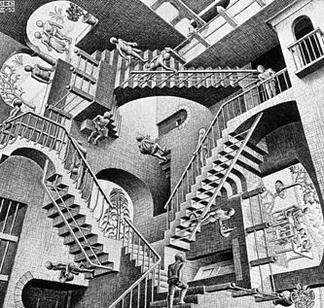
M. C. Escher, Relativity
When teaching tessellations to my Geometry class, my students and I stumbled upon some really great paintings from Escher. He has one with birds and fish called "Sky and Water I." It is a repetitive pattern of objects and one blends into another. Really awesome. The one above is an infinite staircase with no destination. The staircases are located in several sections of the painting and each one is a matter of perspective. For instance, the one in the middle has an individual walking up/ down the stairs from both above and beneath the staircase. Really cool!
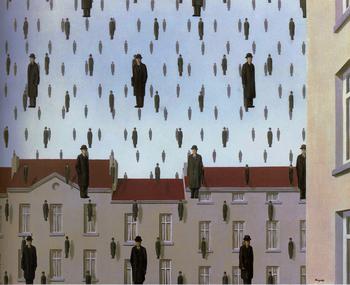
Rene Magritte, Golconde
Magritte is another favorite of mine. He takes realistic locations, objects and people and adds a little twist to each painting. There is one called "The Portrait," and it depicts a very common table setting. However, in the middle of the plate is a piece of ham and the ham has an eye in it's center. A little creepy if you ask me but I suppose Magritte was looking for a reaction. The one above is called "Golconde." I like to call it "Raining Men" but my friends tell me that hubby will spank me if he finds out I am gawking at men falling from the sky. :P
Salvador Dali, Swans Reflecting Elephants
This one is a fairly new find for me. My friend and co-worker, P. Taylor, introduced me to Salvador Dali. His paintings are really fantastic. If you look at the photo, you see some swans swimming in the little waterhole. However, upon closer inspection, you see that the swans' reflections are elephants! In the rock face, there are subtle outlines of both animals and I'm sure if I could see an enlargement of this painting, there would be more treasures to find.
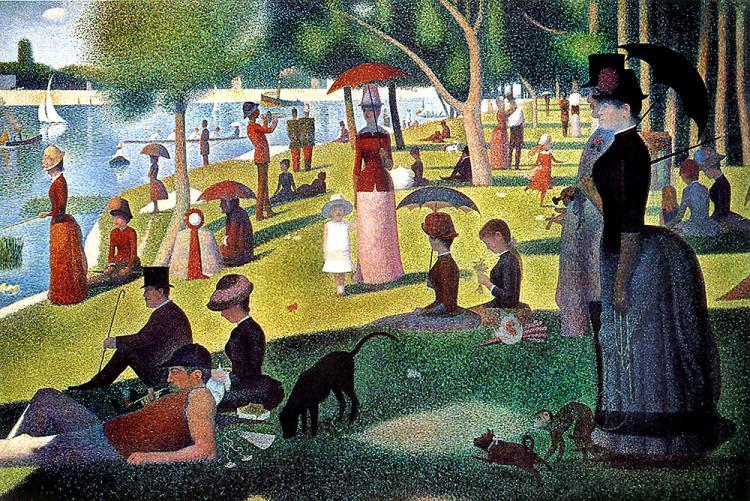
Georges-Pierre Seurat, A Sunday Afternoon on the Island of La Grande Jatte
It's vibrant, not really surrealism but truly wonderful. It's a masterpiece that insightfully conveys the subtleties of color, light and form. There is a playfulness from the pets and most individuals seem to be facing the lake. The people in the painting have faces but are obscured somewhat in the style of Monet's Waterlilies. The parasols and bustles are typical of the late 19th century fashion for women. Beautiful painting. Thanks to my friend and co-worker, R. Mills, for finding it for me!
Look familiar? Yes, it is my favorite sitcom, The Office and in this cover art shot for Season 8, the photographer mimics Seurat's Sunday Afternoon by placing the cast in the same poses as the painting. Nice!
What is your favorite artist, painting, or period in art history?
Image 1 taken from Wikimedia Commons.
Image 2 taken from Wikimedia Commons.
Image 3 taken from here.
Image 4 taken from here.
Image 5 taken from here.
Image 6 courtesy of Comics Bulletin.
Writing with Purpose on Topical Tuesday
I'm on a bit of a blog sabbatical but happy to break it up with a post here where the Burrowers hang out! As it is, I've been thinking a bit about something that could be topical. I suppose I've been thinking about some news stories of the day and what they might mean. I've also been reading the fantastic Barbara Kingsolver and her last novel 'The Lacuna'. In Kingsolver's astounding prose - history begins to shimmer and shine - and this book is about the how of history. In this novel a boy is reared in a series of unstable but interesting environments - both in Mexico and the United States. He becomes part of Frida Kahlo and Diego Rivera's household and is there when they give refuge to Trotsky. The story moves from Mexico City to the United States and the man, Harrison Shepherd's evolvement as an author. I don't want to get all deconstructionist on you but this is a masterful work and one of the astounding stories in it is how public opinion is formed and influenced by the media and by its own needs.
Which brings me to the topic of topical Tuesday.
If we are humans who wish to enrich the world and who also write - how might we infuse our work without it becoming pendantic, scolding or just plain tedious? I suppose we might look to Kingsolver for some aid with that. All of her novels (and her essays and non-fiction) have dealt with issues of social injustice, of misguided do-gooders and the wavering flicker of human's desire to wake up to what is, and take responsibility for changing that which promotes injustice. She did it with Bean Trees, with The Poisonwood Bible and she has done it in The Lacuna in a compelling way. Not once have I felt talked down to or scolded - no, I've become inspired to look at how this portrayal of life from the 30's to the 50's can be mirrored in our society today.
I know others can do this as well - Atwood's The Handmaiden's Tale, is a cautionary story of what could happen should fundamentalists of any stripe gain accendency. Graham Greene's novel The Quiet American, showed us how destructive unexamined good intentions can be. Annie Proulx's That Old Ace in the Hole seduced many into examining the complexities of industrial farming. None of them touted these as their themes, for had they we might have yawned, nay, would have yawned and turned away.
How about you? What do you read or write that shines a light on the wounded systems of thinking that might prevail in our world? Do you know authors that enlighten us to social injustice without condescending or hammering?
Which brings me to the topic of topical Tuesday.
If we are humans who wish to enrich the world and who also write - how might we infuse our work without it becoming pendantic, scolding or just plain tedious? I suppose we might look to Kingsolver for some aid with that. All of her novels (and her essays and non-fiction) have dealt with issues of social injustice, of misguided do-gooders and the wavering flicker of human's desire to wake up to what is, and take responsibility for changing that which promotes injustice. She did it with Bean Trees, with The Poisonwood Bible and she has done it in The Lacuna in a compelling way. Not once have I felt talked down to or scolded - no, I've become inspired to look at how this portrayal of life from the 30's to the 50's can be mirrored in our society today.
I know others can do this as well - Atwood's The Handmaiden's Tale, is a cautionary story of what could happen should fundamentalists of any stripe gain accendency. Graham Greene's novel The Quiet American, showed us how destructive unexamined good intentions can be. Annie Proulx's That Old Ace in the Hole seduced many into examining the complexities of industrial farming. None of them touted these as their themes, for had they we might have yawned, nay, would have yawned and turned away.
How about you? What do you read or write that shines a light on the wounded systems of thinking that might prevail in our world? Do you know authors that enlighten us to social injustice without condescending or hammering?
30 January 2012
Some Parts From The Watery Tart
Hmm, 'Reading Monday'. A fairly straightforward topic - a review on something I have read recently, preferably a book. To be truthful, I haven't read a proper book for a while. The hubby got me an iPad for Christmas, complete with on board Kindle, so I have been reading on that lately. Yes, it's still 'book reading', but much as I love my gadget, it's not quite the same thing. Plus the stuff I have read on there have mostly been the free classics that you can download, which are so universally well-known, they don't need a review from me.
I have also been reading all about jaw surgery. Admittedly, that's not 'book reading' as such, but it's taken up a lot of my reading time lately nonetheless. My son will have to undergo surgery on his jaw within the next few years because apparently braces alone will not fix the problems he has with his teeth. This is probably not something that will interest you if I were to review all that I had read about it though.
The thing that I have been reading the most, though, is my manuscript. Not only did I give it two solid readings, I also nit-picked it to the best of my ability in order for it to be presentable for entry to this year's Amazon Breakthrough Novel Award. This is not the first time that ABNA has been mentioned on here, so I won't go into any more details on it in case I invoke an epidemic of eyerolling and yawns. But I will leave you with something to read for yourself - the all-important 'pitch' that will see me either fall into the abyss with 3,999 other authors, or will allow me to continue on the path to ABNA glory with 999 other hopefuls.
As well as a little read, I also pose a small question. I wrote the pitch all on my own, but the Burrow's very own Watery Tart threw in a couple of last minute suggestions, and they were so fabulous that I edited them into my entry a couple of days ago. See if you can guess what they are... I'm betting you can. *winks*
Take one damsel unknowingly in distress, add a fairy godmother, a spattering of clothing mishaps, and a prince-in-the-making. Mix thoroughly and let simmer for a while.
Twenty-four year old Eleanor Gibson is average in pretty much every way. There’s nothing wrong with her life; it’s just not very exciting, despite being surrounded by lingerie all day long.
Then comes the day when her cat starts to talk, and if that wasn’t enough to make life a little more interesting, the feline insists she is Ella’s fairy godmother too. Throw in an evil ex-stepmother, a bloke called Charming, and a looming party-cum-ball, and you have all the elements of a classic tale. Ella even has a couple of ugly sisters, never mind that they are a pair of gorgeous gay men.
Ella’s not your typical fairy-tale princess though, and it will take more than a discarded glass slipper to get her man. It’s quite possible that she may have to curb her enthusiasm for cursing just a wee bit, not to mention her love of vodka. And can Muse, her surprisingly straight-laced feline friend, overcome her prudishness long enough for Ella to sneak a kiss or three with her intended beau?
Cue plenty of laughs, cursing, accidental nudity, and several trips to the local hospital, as Ella flies from one disaster to the next in her quest to capture her very own Prince Charming.
CARDIFFELLA is a comic retelling of Cinderella set in present day Cardiff.
ABNA image.
27 January 2012
Happy Birthday, Mozart (et al.)
Yup, that's right - Johannes Chrysostomus Wolfgangus Theophilus Mozart celebrates his 256th birthday today (at least if you believe in ghosts). He's certainly worthy of the recognition - his 600+ surviving works span nearly every genre and in many cases are among the finest examples of the form. My personal favourites are the string quartets, of course - since Mozart himself played the viola, the viola parts tend to be both idiomatic and expressive (unlike the frequently boring parts some of his contemporaries stuck us with).
And yet, for all the accomplishments of his life, he was only 35 years old when he died. An impressively prolific fellow, to be so well-remembered so long after his death based on what he produced in a relatively short time. But would you believe there's another child prodigy composer who was born on this date? With the same first two names (save for translation), even? There was, though. He was Juan Crisóstomo Jacobo Antonio de Arriaga y Balzola, or simply Arriaga, a Spanish-born composer who entered the world on what would have been Mozart's 50th birthday. And he died - get this - ten days short of his 20th birthday. Admittedly he's not as famous as ol' Wolfgang, but I've played his three string quartets and they're quite lovely, and when you consider that he died at an age when most people today are somewhere in the middle of college, the fact that he created pieces worth remembering and performing is rather remarkable in itself.
Anybody else famous? Indeed, we need go only to 1823 to encounter yet another composer, Edouard Lalo, who, though he fails to reach Mozart's heights, is still a frequent sight on concert programs, his Symphonie Espagnole and Cello Concerto being particularly popular among young players. (He achieved the reasonably ripe age of 59, as well, so the date's apparently not cursed after all.) Oh, and we can't forget Lewis Carroll, or Charles Lutwidge Dodson as he was baptized - 'twas brillig, and the slithy toves, eh?
Then again, it's also the birthday of one Edward Smith - a mind-bogglingly common name, but the the one I'm thinking of is the one who went down with his ship. Which ship? Why, the Titanic.
Hmmm.
You know, I think I'm rather glad I don't share this birthday! Still - anybody want cake? ;-)
And yet, for all the accomplishments of his life, he was only 35 years old when he died. An impressively prolific fellow, to be so well-remembered so long after his death based on what he produced in a relatively short time. But would you believe there's another child prodigy composer who was born on this date? With the same first two names (save for translation), even? There was, though. He was Juan Crisóstomo Jacobo Antonio de Arriaga y Balzola, or simply Arriaga, a Spanish-born composer who entered the world on what would have been Mozart's 50th birthday. And he died - get this - ten days short of his 20th birthday. Admittedly he's not as famous as ol' Wolfgang, but I've played his three string quartets and they're quite lovely, and when you consider that he died at an age when most people today are somewhere in the middle of college, the fact that he created pieces worth remembering and performing is rather remarkable in itself.
Anybody else famous? Indeed, we need go only to 1823 to encounter yet another composer, Edouard Lalo, who, though he fails to reach Mozart's heights, is still a frequent sight on concert programs, his Symphonie Espagnole and Cello Concerto being particularly popular among young players. (He achieved the reasonably ripe age of 59, as well, so the date's apparently not cursed after all.) Oh, and we can't forget Lewis Carroll, or Charles Lutwidge Dodson as he was baptized - 'twas brillig, and the slithy toves, eh?
Then again, it's also the birthday of one Edward Smith - a mind-bogglingly common name, but the the one I'm thinking of is the one who went down with his ship. Which ship? Why, the Titanic.
Hmmm.
You know, I think I'm rather glad I don't share this birthday! Still - anybody want cake? ;-)
25 January 2012
The Weight of the World
As of late I've been carrying the weight of the world on my shoulders. I know that I, as a historian, should be able to distance myself from the terrible things I read about. I should be able to treat it professionally, and without letting my own emotions or morality get in the way.
The problem isn't that I can't. The problem is that I won't.
World War Two. The largest conflict in human history. Unfathomably large numbers of people killed, wounded and abused. Unspeakable atrocities on all sides. If World War One was what lost us our innocense, World War Two certainly confirmed that there was no way back. The loss of civilian lives were not only collateral damage in this war; civillians were targets.
Reading about air raids, firebombings, Manchuria and - last but definitely not least - the atomic bombs, I feel obliged to remember that this is more than numbers and figures. It's about people. People who suffered. Who died.
And it's about people who made decisions.
Good people? Evil people? Somewhere-in-between people?
No one if neutral or objective in history. No one should be. Even if we need to understand more than one aspect; we're allowed (and, in my mind, bound), to have opinions and bias. You just need to be aware of it, and try not to let it affect your professional work too much.
If you want to carry the weight of the world too, you may watch the video below. It is long. But it should make you feel something. (And not just about atomic bombs, if you make it past the first ten minutes)
My sincerest appologies for forsaking "Writing Wednesday" for "Cruella pours her heart out (but still couldn't resist the photoshopped image of the 'big three'...)".
Labels:
awareness,
Cruella Collett,
history,
Japan,
Love,
nuclear calamities
24 January 2012
Amazon Breakthrough Frenzy
Oh, sure. When we are talking about Topical Tuesday I could talk about SOPA or the Chinese New Year (which I actually did yesterday, and that was more timely), but my head is FULL of ABNA ABNA ABNA... It is just that time of year.
I know I've talked here of the Amazon Breakthrough Novel Award Contest and I think Tara mentioned it here a while back, but NOW IT'S OPEN! EVERYBODY PANIC!
*cough*
Yeah, sorry about that. It's just... this is the only thing I've ever done that combines the TENSION of Querying with the Adrenaline and Group support of a WriMo. It is the good and the bad of writing tension all rolled in one pretty little package. Only it isn't pretty.
But what I want to do here is a little bit of COUNTERING. I've seen some former ABNA entrants nod out this year. They site the rules and how much authors give up, and I admit, it isn't for everybody.
People I Believe should FOREGO ABNA
1 – People who have written a sure best seller. If you look at best seller charts, these are mostly thrillers and books by Jodi Piccoult. If these apply to you, this may not be your contest. Seriously though--some books are going to get nice big advances and sell millions--if you have one of these books, chances are the prizes here will not look all that great to you. James Patterson need not apply.
2 – One trick ponies with intentions to sell this and only this NOW. The contest puts you on hold with THIS WORK. If this is your ONLY work and you want to market it to publishers, you will not be able to for 6 months. That seems a very long time if you only have one book. You CAN during this time seek an agent. You can also write other books, shop other books, polish other books—heck, you can polish THIS book—the only time that isn't helpful is if they loved the earlier version so much they won't take your changes.
The things you give up are:
The right to negotiate IF YOU WIN. The contract is the contract is the contract. But you know what? They can't afford to have it not be a FAIR contract. I HAVE a Penguin contract, and I just don't believe they gain anything by screwing over a winner. AND if you win, you take that through your WHOLE career. Listen to it: “Tara's first books won the Amazon contest in 2012.” Isn't that a tag you'd love to carry forever?
[I am picking on Tara, as this is her first year entering—I finally managed to lead one of my fellow Burrowers into this addictive thing.]
TIME: As mentioned above, while you are entered, you can't shop it to publishers. If you are a finalist, Penguin gets the right to offer for 30 days and if you can't come to terms then they have the right to counter any other offer you get. (hello, bidding war)
But here are the things you GAIN:
Understanding of the PROCESS of selling a book: This system is very much like the query—you are judged first pitch, then partial, then full.
Networking: This is a truly supportive system of people (though there are places on the discussion boards that can be contentious, so beware)
Professional feedback: now this is a reward if you get past the pitch stage, but it is REALLY NICE. It is ALSO to be taken with a grain of salt, as readers are NOT matched by genre with their interests, so there is some crap shoot to it. Still, it is a good learning experience.
And if you WIN? A HUGE marketing coup--all the support of Penguin behind you, all the marketing credentials of winning a contest this huge... It's really big. Even being a semi-finalist last year got me an agent.
So don't be afraid, my friends... Dive in!
And just for the fun of it, this is my entry this year:
Ten-year old Peter Popescue doesn’t know his family is holding evidence that could bring down an international crime family. All he knows is his mother’s been missing for months and his dad has been teaching him and his siblings how to stay hidden. A loud crack in the night wakes him and he struggles to stay silent as he witnesses his father's execution. Worried they may be the next targets, Peter, Kade, and an emotionally fragile Tasha realize it's time to put their invisibility plan into action until they can find their mom.
In downtown Portland, Athena Garnett, a street-smart runaway, helps them defuse a gang situation that is turning ugly. Tasha takes a fondness to thirteen-year old Athena and Athena helps them gather some resources they need. They invite her to hide with them as the weather turns colder. In exchange, she offers to help solve the clues they believe will help find their mother: clues that lead them on an unusual treasure hunt through Portland involving stolen art, hidden money, and foreign gangsters. But the most ominous clue is a name that suggests all of their lives have been intertwined since long before they were born and that their legacies place them on opposite sides of a mob war.
Legacy, a young adult suspense novel combines the gritty adventure feel of Melissa Marr, the difficult sibling journey of Cynthia Voigt's Homecoming with the art theft and high adventure of Ally Carter's Heist Society. Ultimately, it is about what happens to children who are left holding the pieces of their parents' explosive lives.
I'd love to know what you think--there is still time to tweak it.
I know I've talked here of the Amazon Breakthrough Novel Award Contest and I think Tara mentioned it here a while back, but NOW IT'S OPEN! EVERYBODY PANIC!
*cough*
Yeah, sorry about that. It's just... this is the only thing I've ever done that combines the TENSION of Querying with the Adrenaline and Group support of a WriMo. It is the good and the bad of writing tension all rolled in one pretty little package. Only it isn't pretty.
But what I want to do here is a little bit of COUNTERING. I've seen some former ABNA entrants nod out this year. They site the rules and how much authors give up, and I admit, it isn't for everybody.
People I Believe should FOREGO ABNA
1 – People who have written a sure best seller. If you look at best seller charts, these are mostly thrillers and books by Jodi Piccoult. If these apply to you, this may not be your contest. Seriously though--some books are going to get nice big advances and sell millions--if you have one of these books, chances are the prizes here will not look all that great to you. James Patterson need not apply.
2 – One trick ponies with intentions to sell this and only this NOW. The contest puts you on hold with THIS WORK. If this is your ONLY work and you want to market it to publishers, you will not be able to for 6 months. That seems a very long time if you only have one book. You CAN during this time seek an agent. You can also write other books, shop other books, polish other books—heck, you can polish THIS book—the only time that isn't helpful is if they loved the earlier version so much they won't take your changes.
The things you give up are:
The right to negotiate IF YOU WIN. The contract is the contract is the contract. But you know what? They can't afford to have it not be a FAIR contract. I HAVE a Penguin contract, and I just don't believe they gain anything by screwing over a winner. AND if you win, you take that through your WHOLE career. Listen to it: “Tara's first books won the Amazon contest in 2012.” Isn't that a tag you'd love to carry forever?
[I am picking on Tara, as this is her first year entering—I finally managed to lead one of my fellow Burrowers into this addictive thing.]
TIME: As mentioned above, while you are entered, you can't shop it to publishers. If you are a finalist, Penguin gets the right to offer for 30 days and if you can't come to terms then they have the right to counter any other offer you get. (hello, bidding war)
But here are the things you GAIN:
Understanding of the PROCESS of selling a book: This system is very much like the query—you are judged first pitch, then partial, then full.
Networking: This is a truly supportive system of people (though there are places on the discussion boards that can be contentious, so beware)
Professional feedback: now this is a reward if you get past the pitch stage, but it is REALLY NICE. It is ALSO to be taken with a grain of salt, as readers are NOT matched by genre with their interests, so there is some crap shoot to it. Still, it is a good learning experience.
And if you WIN? A HUGE marketing coup--all the support of Penguin behind you, all the marketing credentials of winning a contest this huge... It's really big. Even being a semi-finalist last year got me an agent.
So don't be afraid, my friends... Dive in!
And just for the fun of it, this is my entry this year:
![]() |
| Cover designed by Joris Ammerlaan |
In downtown Portland, Athena Garnett, a street-smart runaway, helps them defuse a gang situation that is turning ugly. Tasha takes a fondness to thirteen-year old Athena and Athena helps them gather some resources they need. They invite her to hide with them as the weather turns colder. In exchange, she offers to help solve the clues they believe will help find their mother: clues that lead them on an unusual treasure hunt through Portland involving stolen art, hidden money, and foreign gangsters. But the most ominous clue is a name that suggests all of their lives have been intertwined since long before they were born and that their legacies place them on opposite sides of a mob war.
Legacy, a young adult suspense novel combines the gritty adventure feel of Melissa Marr, the difficult sibling journey of Cynthia Voigt's Homecoming with the art theft and high adventure of Ally Carter's Heist Society. Ultimately, it is about what happens to children who are left holding the pieces of their parents' explosive lives.
I'd love to know what you think--there is still time to tweak it.
23 January 2012
Something-something Monday: Five Questions for You
English Wikipedia was blacked out last Wednesday in protest of the pending SOPA legislation. No doubt this prompted some of you socially responsible-type people to read up on the issue, discuss it with colleagues, and perhaps contact your congressional representative.
But that's not me. I spent the day wondering who would answer all of my important questions in a post-wikipedia apocalypse. I thirst for knowledge, and a quick look at my own browser history shows how incredibly enlightened my curiosity is: Which of the Valar created the dwarves? What can I learn about Halloween within 45 seconds that will make my web comment sound intelligent? When did Worf arrive on Deep Space Nine? Is Danica McKellar already married?
These questions, of course, have already been answered (Aulë, a vague reference to Samhain coupled with the implication that I have strong opinions about Pope Gregory III, Season Four, and, sadly, yes).
But as a contingency against future disaster, I've decided to do something of a dry run and test my ability to get answers without Wikipedia. So here's what's on my mind today:
Can you cook an egg in the oven?
Obviously, you can break open an egg and dump its innards into a cake or whatever and cook that in an oven. But what if you want a scrambled egg and, like me, don't have a stove? For that matter, what about a whole egg? Can I wrap one in aluminum foil and stick it in my toaster oven? Is that a stupid question? Was that a stupid question?
Did they wear sunglasses a thousand years ago? Why not?
I know from previous research that some form of magnifying/corrective glasses have been around since at least medieval times (I saw a bespectacled monk or something in a movie), and handheld lenses for even longer.
I'm a night owl-- I work the graveyard shift-- and even indirect sunlight bothers me. Surely the Classical-era peasants who worked overnights to stock Roman grocery stores where of similar disposition, and I can't imagine humanity just got by squinting for thousands of years.
And when you think about it, blocking out a portion of light has to be much easier than refocusing it. It would surely be worth the effort if you were planning to fight a battle in the daytime (which I know-- again, thanks to movies-- was the normal modus operandus, unless there was a fire-breathing dragon involved). I suppose an ancient general could've handed out veils, but then his soldiers would look like escapees from the nearest harem. Not very manly.
Is there something like a Hippocratic Oath for lawyers? Shouldn't there be?
By 'Hippocratic Oath', of course, I do not mean the Hippocratic Oath at all (it says something about helping whomever is in need), but the rule that says "first, do no harm". I don't know what that's called. See where I am without Wikipedia?
At any rate, there should be a #1 rule for lawyers that says "first, tell no lies". Seriously. I'm not advocating that we revoke the tradition of attorney-client privilege and expect them to reveal everything they've discussed. Rather, I want to overturn the paradigm whereby an attorney considers it his ethical duty to serve his client at the expense of right. So if a suspect tells his lawyer, "Yeah, I killed the guy. Help me get away with it", then the lawyer should say, "I recommend you confess; otherwise I'll recuse myself, you'll get a new lawyer, and you'll have to make up lies on your own without coaching."
I'm not under the delusion that all lawyers would comply. But it would be nice to at least acknowledge a professional ethic that doesn't allow them to condone, encourage, or assist with dishonesty.
What's the deal with foul balls?
A good, solid hit-- what the batter is normally attempting-- results in a line drive. Base hit.
A total whiff results in a strike.
If we apply a simple continuum, then a foul ball is the next worst thing (you barely made contact). So why does that earn you more pitches, whereas a pop fly or grounder-- resulting from better execution of the swing-- results in an out? If we played (American) football that way, then a quarterback sack would result in a loss of down with no loss of yardage, and on third down it would result in a replay. Thppp!
I realize this is more in the nature of bitching than asking questions, but sometimes that's how society moves forward. I expect Einstein was bitching about Michelson & Morley's failure to measure the ether when he came up with his clever ideas, and it took some caveman bitching about the cold to spur the invention of fire ("shut up already and stick your hand in this... happy, now?").
Seriously, how difficult is it to run a secure zoo?
Criticizing faulty realism in bad movies is like fitting fish in a barrel. But Jurassic Park is a good movie overall, and this isn't about the obvious science errors. Rather, I question whether or not a large corporation with hundreds of millions to invest, and billions at stake, could possibly fail to keep some lizards under control.
Yeah, animals are tricky. I get that. But it's the little, swarming critters that give humans problems. I'm not going to check Wikipedia (of course), but I've been to zoos, and I've seen plenty of nature shows. If you put a tiger behind steel bars, it will stay there. If you put a grizzly bear in a 20-foot deep concrete pit, it will not jump out. Lizards are much slower and significantly stupider. Have you seen the segment on Komodo Dragons in BBC's Life? Even running loose those things couldn't hurt an alert 10-year-old.
Not that I've verified that with some unwilling test subject. No. That would be wrong. The kid was eleven, and he volunteered.
And my lawyer has advised me that the above statement can be construed as hyperbole, and is therefore not incriminating, and if he knows the real truth he ain't sayin'.
So if you have any answers or clarifications (but no accusations, please), then feel free to share.
Cheers,
Jason
But that's not me. I spent the day wondering who would answer all of my important questions in a post-wikipedia apocalypse. I thirst for knowledge, and a quick look at my own browser history shows how incredibly enlightened my curiosity is: Which of the Valar created the dwarves? What can I learn about Halloween within 45 seconds that will make my web comment sound intelligent? When did Worf arrive on Deep Space Nine? Is Danica McKellar already married?
These questions, of course, have already been answered (Aulë, a vague reference to Samhain coupled with the implication that I have strong opinions about Pope Gregory III, Season Four, and, sadly, yes).
But as a contingency against future disaster, I've decided to do something of a dry run and test my ability to get answers without Wikipedia. So here's what's on my mind today:
Can you cook an egg in the oven?
Obviously, you can break open an egg and dump its innards into a cake or whatever and cook that in an oven. But what if you want a scrambled egg and, like me, don't have a stove? For that matter, what about a whole egg? Can I wrap one in aluminum foil and stick it in my toaster oven? Is that a stupid question? Was that a stupid question?
Did they wear sunglasses a thousand years ago? Why not?
I know from previous research that some form of magnifying/corrective glasses have been around since at least medieval times (I saw a bespectacled monk or something in a movie), and handheld lenses for even longer.
I'm a night owl-- I work the graveyard shift-- and even indirect sunlight bothers me. Surely the Classical-era peasants who worked overnights to stock Roman grocery stores where of similar disposition, and I can't imagine humanity just got by squinting for thousands of years.
And when you think about it, blocking out a portion of light has to be much easier than refocusing it. It would surely be worth the effort if you were planning to fight a battle in the daytime (which I know-- again, thanks to movies-- was the normal modus operandus, unless there was a fire-breathing dragon involved). I suppose an ancient general could've handed out veils, but then his soldiers would look like escapees from the nearest harem. Not very manly.
Is there something like a Hippocratic Oath for lawyers? Shouldn't there be?
By 'Hippocratic Oath', of course, I do not mean the Hippocratic Oath at all (it says something about helping whomever is in need), but the rule that says "first, do no harm". I don't know what that's called. See where I am without Wikipedia?
At any rate, there should be a #1 rule for lawyers that says "first, tell no lies". Seriously. I'm not advocating that we revoke the tradition of attorney-client privilege and expect them to reveal everything they've discussed. Rather, I want to overturn the paradigm whereby an attorney considers it his ethical duty to serve his client at the expense of right. So if a suspect tells his lawyer, "Yeah, I killed the guy. Help me get away with it", then the lawyer should say, "I recommend you confess; otherwise I'll recuse myself, you'll get a new lawyer, and you'll have to make up lies on your own without coaching."
I'm not under the delusion that all lawyers would comply. But it would be nice to at least acknowledge a professional ethic that doesn't allow them to condone, encourage, or assist with dishonesty.
What's the deal with foul balls?
A good, solid hit-- what the batter is normally attempting-- results in a line drive. Base hit.
A total whiff results in a strike.
If we apply a simple continuum, then a foul ball is the next worst thing (you barely made contact). So why does that earn you more pitches, whereas a pop fly or grounder-- resulting from better execution of the swing-- results in an out? If we played (American) football that way, then a quarterback sack would result in a loss of down with no loss of yardage, and on third down it would result in a replay. Thppp!
I realize this is more in the nature of bitching than asking questions, but sometimes that's how society moves forward. I expect Einstein was bitching about Michelson & Morley's failure to measure the ether when he came up with his clever ideas, and it took some caveman bitching about the cold to spur the invention of fire ("shut up already and stick your hand in this... happy, now?").
Seriously, how difficult is it to run a secure zoo?
Criticizing faulty realism in bad movies is like fitting fish in a barrel. But Jurassic Park is a good movie overall, and this isn't about the obvious science errors. Rather, I question whether or not a large corporation with hundreds of millions to invest, and billions at stake, could possibly fail to keep some lizards under control.
Yeah, animals are tricky. I get that. But it's the little, swarming critters that give humans problems. I'm not going to check Wikipedia (of course), but I've been to zoos, and I've seen plenty of nature shows. If you put a tiger behind steel bars, it will stay there. If you put a grizzly bear in a 20-foot deep concrete pit, it will not jump out. Lizards are much slower and significantly stupider. Have you seen the segment on Komodo Dragons in BBC's Life? Even running loose those things couldn't hurt an alert 10-year-old.
Not that I've verified that with some unwilling test subject. No. That would be wrong. The kid was eleven, and he volunteered.
And my lawyer has advised me that the above statement can be construed as hyperbole, and is therefore not incriminating, and if he knows the real truth he ain't sayin'.
So if you have any answers or clarifications (but no accusations, please), then feel free to share.
Cheers,
Jason
Subscribe to:
Posts (Atom)


